Cult Icon
2585 replies · 37572 views


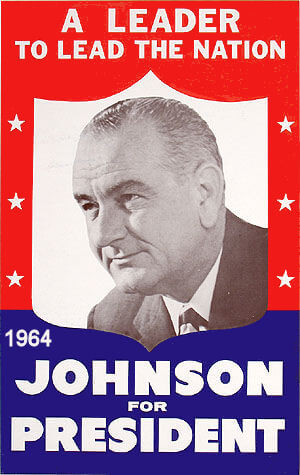

LBJ III pg 1133
"The strategy was flawless. Thanks to the new allies Russell’s speech had won for the South, there was now little danger that the bill would come to a vote if the southerners didn’t want it to."
"Russell’s speech would have, and felt it would destroy his last hopes of getting a compromise, and that he had, in Tommy Corcoran’s phrase, “given up,” and wanted to be identified as little as possible with another civil rights defeat. He stayed on his ranch for two weeks, continuing his months-long public silence on the issue but removing himself as far from the Washington spotlight as possible."
“As you probably know,” the memo said, “both your friends and your enemies are saying that this is Lyndon Johnson’s Waterloo. They are saying that you are trapped between your southern background and your desire to be a national leader and that you cannot escape. I personally think this is Armageddon for Lyndon Johnson. To put it bluntly, if you vote against a civil rights bill you can forget your presidential ambitions in 1960.”
To keep those ambitions alive, Rowe’s memorandum said, it was necessary for Johnson not merely to vote for a civil rights bill but to fight for one. “Lyndon Johnson would have to be active in bringing about cloture” if that was necessary. It was necessary not merely that he fight but that he win. “The important thing about civil rights in 1957 is to pass a civil rights bill… solely for the purpose of getting this absurd issue off the Hill for a few years….” And, Rowe said, it was necessary that the bill that was passed not be identified as a Republican bill but as a Lyndon Johnson bill. “The public relations … are most important. It would be most important that Johnson get all the credit for getting a compromise bill through.”
on July 6, Lyndon Johnson returned to Washington, hard as he had fought before for the civil rights bill, now, with the fight seemingly lost, he fought harder."
"
"Immediately upon his return to Washington on July 6, Johnson, “aware,” as Rowland Evans was to put it, of Russell’s “rare ability to articulate his point,” urged him to accept, urged him so forcefully that, on July 10, Russell met with the President for almost an hour."
"LBJ III pg 1151
*Johnson was in cahoots with the owner of the Washington Post to shape political action
"But Philip Graham, in daily touch with Johnson, had a better understanding of the situation, and on Wednesday his Washington Post said simply, “The Senate has begun what may become its most momentous filibuster.” "
"“I BELIEVE THE BILL WAS STRENGTHENED” by the amendment, Lyndon Johnson told reporters after the vote. It had not been strengthened, of course, but weakened, weakened quite drastically. "
"IF ONE ASPECT of legislative leadership is a talent for compromise, for determining the essence of different points of view (what Lyndon Johnson called “listening”), and then for composing those differences—locating a common ground, and then, through negotiating, bringing both sides to that place—there is another aspect of legislative leadership that is also a form of compromise, but on another, higher level, for there are cases in which listening and reconciliation cannot help, cases in which the differences between the two sides are so deep that no meeting place can be located, for no such place exists. For legislation to be enacted in such cases, it is necessary for a legislative leader to create a common ground."
LBJ III pg 1156
" A jury trial amendment was part of the South’s price—its rock-bottom, non-negotiable price—for not filibustering. And in its fight on this issue, the South would not have to stand alone."
"The chasm between the two sides seemed unbridgeable. “Every so often the play of history turns up an issue so full of personal and regional conflict, so grounded in moral philosophy, and so subject to the clash of ancient but contending principles, that it stands apart from all the normal preoccupations of political life,” James Reston wrote. “Such an issue is now before the Senate….”
“At this point,” George Reedy writes, “Johnson rose to what I will always regard as his greatest height…. He was absolutely determined that there would be a bill…. Against all reason, Johnson kept insisting that a compromise must exist somewhere…. Most observers thought that [the] two poles were too far apart to find a middle ground. But using the same set of facts, LBJ insisted that the reality was the other way around—that if two opposing sides had a degree of validity in their contentions, there simply had to be a legitimate way of meeting them both.”
IF THERE WAS A WAY, Lyndon Johnson was going to find it. “He pleaded and threatened and stormed and cajoled,” Reedy recalls. “He prowled the corridors of the Senate grabbing senators and staff members indiscriminately, probing them for some sign of amenability to compromise.”
he had “spent hours on the phone in nonstop conversations with the most ingenious legal minds he knew,” pleading with Corcoran, Rowe, Clifford, Fortas, Acheson, and a dozen other lawyers “for something to break the logjam.” He had had Tommy Corcoran assemble a group of lawyers—a dozen leading legal minds of the New and Fair Deals—in the conference room at Corcoran & Rowe, and Corcoran had told them how important it was that a solution be found: “You know, we’re all pros here, and we can talk to each other. We know we’re here to elect Lyndon Johnson President. Who’s kidding whom, and let’s get going!” Dean Acheson put several bright associates at his law firm, Covington & Burling, to work on the problem. Senators were flooding the Democratic Policy Committee with amendments and suggestions for amendments (O’Mahoney edited and reedited the version he had introduced), where they were run by the committee’s lawyers, Siegel and the brilliant Solis Horwitz. “We drafted twenty-five or thirty different versions,” Horwitz was to recall. “We were constantly trying to satisfy both sides.” The search grew desperate. “O’Mahoney kept introducing these various amendments one right after the other. It got ridiculous….” Each suggestion proved to have a fatal weakness; some foundered on conflicts with other statutes already on the books, others on either the rock or the hard place: every amendment that would add to the civil rights bill a provision that required jury trials—in no matter what form—was totally unacceptable to liberals; every amendment that did not include an absolute guarantee of jury trials was totally unacceptable to Russell and the South.
LBJ III pg 1166
The odds against passage of the civil rights bill were still very long. The South was willing—to avoid being forced to filibuster, and also to help Lyndon Johnson become President—to accept a weak bill, and since the amendment’s new version still contained a jury trial guarantee, it was still weak enough for the South to accept it. Republicans and liberals, however, still would not accept it. "
"To keep the two sides negotiating—to keep the 1957 civil rights fight from degenerating into the open hostility and bitterness on the Senate floor in which so many previous civil rights bills had died—he had to persuade them to conduct the debate in an atmosphere of outward friendliness and respect, or at least civility, so for some days after Part III had been disposed of, the opening scene of the Senate each noon hour featured the Majority Leader as Emily Post.
In statements written by Reedy and delivered during his opening remarks each day, Johnson encouraged the Senate to mind its manners, saying on one day that the Senate was on trial, that the world was watching it, and that he was confident that the Senate would do itself proud, that his colleagues would “continue the debate as reasonable men.” On another day, he said he was happy to see that his confidence was justified. “Never before have I seen in the Senate a debate which has contributed so much to understanding. In that sense, I think the debate has been one of the finest the Senate has ever had.” Day after day, he reminded his colleagues that they were taking part in an historic debate, repeated his plea that they be fair and open-minded, open to reason and compromise, and praised them for being so reasonable and open-minded thus far—which of course made it harder for them to act otherwise, and kept them, as much as possible, on their best behavior"
"All his life, he had had what George Brown called a “knack” for simultaneously convincing people on opposite sides of an issue that he was on their side, and that knack was desperately needed now. He was the only bridge between the two sides, and if he was to keep them negotiating through him, he had to convince each side that it was in its best interest to negotiate through him, that he was trying to obtain for it the best deal that could be obtained; that while it was necessary for him to maintain a veneer of neutrality for the benefit of the outside world, in reality he was on their side, that he believed what they believed, that he was their friend, that he wanted them to win. And never had this knack been more vividly displayed. He did it with the tone of his voice: with northerners, his Texas twang became harder, more clipped; when he talked to southerners the twang softened into a full-fledged southern drawl. He did it with words."
"To do so, he made things personal. "
"He played on their pride as southerners."
"And he played on their fears for themselves—an effective tactic,"
"Because of their distrust of him, he often relayed his word through others. "
LBJ III pg 1170
In contrast to most of his tally sheets, this one was notably untidy, for so intense was the pressure from both sides that senators were changing their votes, and then changing back again—some of them several times; the long, narrow paper was smudged with erasures and covered not only with numbers but with notes he had jotted down to remind him of what might be the best time to approach a particular senator again, or of some new argument that might work with him."
To try to get more votes, he used all the weapons at his command—used them with his customary ruthlessness. The ruthlessness was usually cloaked under senatorial courtesy; it took the form of hints rather than threats. But with these men, threats were not needed. Senators understood the nuances of power; they were well aware that the man asking for their help on the civil rights bill had the power to help them—or not help them—on other bills, bills that were vital to them; to help them with committee assignments or campaign cash or office space."
Use of Pity:
"“Ah don’t want to die right here,” he said. “Ah don’t want to fall on my face, drop dead right on the floor of the Senate.” He couldn’t take much more strain; “He made you feel that if you wouldn’t go along with what he was asking, you might be murdering this man,” one senator recalls."
He used the liberals’ fear of Russell to explain why he couldn’t give them more; when a liberal senator had a suggestion, he would reply that he thought it was a good idea, but of course there was no sense pushing it unless Russell approved.
"He used their pride in the Senate: “We’ve got the world looking at us here! We’ve got to make the world see that this body works!” He used their pride in their party: “You’re the party of Lincoln,” he reminded one Republican. “That’s something to be proud of. You’re the image of Lincoln.” To Democrats, he said, “Our party’s always been the place that you can come to whenever there’s injustice. That’s what the Democratic Party’s for. That’s why it was born. That’s why it survives. So the poor and the downtrodden and the bended [sic] can have a place to turn. And they’re turning to us now. We can’t let them down. We’re down to the nut-cutting now, and we can’t let them down!” He used his power and his charm. "
"When he had finished presenting his arguments to a senator, Harry McPherson was to say, “he would sink back into the chair, his eyes wide with the injustice of his burdens, the corners of his mouth inviting pity and support” Then he “would come back face to face, perhaps sensing that the other wanted to help and in that event should hear the whole story, all the demands, the pressures and the threats, as well as the glory and the achievement that awaited reasonable men if they would only compromise, not on the main thing, but just on this part that the other side would never accept as it was; unless there could be some accommodation, there would be nothing, the haters would take over, the Negroes would lose it all, I need your help.” He used his stories, and he used his jokes, he used his promises, used his threats, backing senators up against walls or trapping them in their chairs, wrapping an arm around their shoulders and thrusting a finger in their chests, grasping lapels, watching their hands, watching their eyes, listening to what they said, or to what they didn’t say: “The greatest salesman one on one who ever lived”—trying to make his biggest sale. Never had he tried harder. In the intensity of his effort, he even instituted a new variation on one of his old devices. Lapels had long been for grabbing, but now he used them—or rather the buttonhole in them—for another purpose. Trying to persuade a senator who was resisting persuasion, Lyndon Johnson would stick his long forefinger through the hole in the senator’s lapel to prevent him from moving away. “The other day,” George Dixon wrote, “I spied Majority Leader Lyndon Johnson holding Senator Estes Kefauver in captive conference. Kefauver couldn’t have gotten away without leaving his lapel behind.”
To every crisis in his life, he had risen with that effort that made men say, “I never knew it was possible for anyone to work that hard,” that effort in which “days meant nothing, nights meant nothing.” Now, in this greatest crisis, Lyndon Johnson, heart attack or no, rose again to that kind of effort. In the early-morning hours the residential districts of Washington and its suburbs were dark and silent, but now, in the night, the silence of a darkened street would be broken by the faint ringing of a telephone in a senator’s house. The senator, picking it up, would hear, “This is Lyndon Johnson.” The persuasion would begin, and it might go on for quite some time. Finally, the call would be over. The senator would go back to bed, to sleep if he could. And on another street, in another senator’s home, the phone would ring. The streets of the Kalorama section of the District were, in the early-morning hours, row after row of darkened houses—and of one house, on Thirtieth Place, in which, night after night during these climactic last weeks of July, every night, lights would be on.
LBJ III pg 1187
"Then, as the man standing at the desk immediately behind him continued to rage, Johnson turned his chair all the way around, either to look right up at Russell—or, as Doris Fleeson suggested, for another reason: so that his face would be concealed from the Press Gallery, “so that the reporters could not judge his reaction to the damage being done” to his plans.
For seven months he had managed to maintain a layer of civility between the liberals and the South—against long odds. But now, “in three hours,” as Mary McGrory wrote, “the veneer of senatorial courtesy which has given a high gloss to … weeks of debate” had cracked wide open. "
"Russell, lashing back at McNamara, had suddenly said, apropos of nothing in his previous remarks, “So, Mr. President, we have tried to act like reasonable men. We have tried to act with restraint in the face of great provocation…. But, Mr. President, we reserve the right to defend ourselves…. As responsible men, we shall insist on our right to be heard fully on all amendments to the pending bill.”"
"The first development could be called a lucky break—unless one believes that man in part makes his own luck, and that if he pushes against a wall long enough and hard enough, refusing to stop, a crack will eventually appear somewhere in the wall; and unless one believes also that the “crack” wouldn’t have produced Senate votes for civil rights had not Lyndon Johnson known, as apparently no one else knew, how to widen it."
"With his eyes focused on organized labor as a source of support for a jury trial amendment, suddenly Johnson saw more. There was one union to whom the memory of the power of federal court injunctions was especially fresh and bitter: the United Mine Workers. "
The center of the UMW’s power was West Virginia. It was a one-industry state, and the industry was coal. No fewer than 117,000 miners, every one of whom belonged to the UMW, lived there. And West Virginia’s two senators were the Republican Chapman Revercomb and the Democratic liberal Matthew Neely, both of whom had refused—Revercomb loudly on the Senate floor, Neely through aides from his hospital bed—to support the jury trial amendment. The UMW’s chief counsel, and a man Lewis trusted as much as he trusted anyone, was none other than Johnson’s friend Welly Hopkins; it had been Hopkins who had dragged the raging Lewis back into his seat in the courtroom in 1946 before Lewis could compound the contempt offense; and then Hopkins, beside himself with anger, had shouted defiantly at the judge, “This day will live in infamy, sir!” Now, on Tuesday morning, Johnson telephoned Welly, and asked him for a formal statement of support from John L. Lewis.
Anderson had to go through channels, with twelve separate brotherhoods. Hopkins had to make only one telephone call."
"
"The Leader had appealed to her husband’s sense of duty. “You’re a senator of the United States,” he told Church. “You have to function as a senator of the United States. This is your national duty.” He appealed to his sense of history—and to his desire to be part of it. “Frank always had a sense of history,” Bethine says, “and he made Frank feel like he would be a big piece of history if he got involved in this.” He appealed to his love of a challenge."
LBJ III pg 1205
Rewards for personal loyalty/service, just as in the office
" these last desperate days of a great battle, to putting in writing some realities of life in the Senate, where projects vital to a senator’s future are at the mercy of leaders and chairmen with long memories.
“Another factor which must be considered,” the memo said, “is the future relationships which Senators will have with their fellow Senators. This frequently affects the type of legislation they can pass in the Senate [italics in text]. '
"there was the committee appointment for which Church had longed. “After a decent interval [after the jury trial addendum], Johnson put him on Foreign Relations, in what was a tacit quid pro quo, which was never expressed, but which I think was understood,” Ward Hower says."
The very next vacancy on Foreign Relations occurred in January, 1959, and Church was appointed to it. In making the appointment Johnson simply bypassed not only Estes Kefauver but Scoop Jackson and a half dozen other senators with greater seniority than Church who had requested the post. Church had wanted “not only to go on” the committee, but “to go on early,” so that he could be chairman, like Borah, someday."
LBJ III pg 1210
"In addition, Johnson had on his side, in Philip Graham, a very potent weapon. Johnson needed that weapon. It was difficult for him to talk directly to some of these leaders—including the one who was probably the single most influential, ADA National Chairman Rauh—so great was their distrust of him. So the weapon had to be deployed, no matter what the cost."
"Graham persuaded Rauh, and Rauh helped persuade Roy Wilkins, who in 1957 was another civil rights leader whose feelings about Lyndon Johnson were, at best, ambivalent."
LBJ III pg 1232
"AUGUST 27, the day of the crucial House of Representatives vote to approve the Senate’s version of the 1957 Civil Rights Act, was Lyndon Johnson’s forty-ninth birthday.
His fortieth birthday had been a very bad day in his life, a day on which it had seemed likely that he would never sit in the United States Senate. August 27, 1948, had been the eve of Election Day in his senatorial contest with Coke Stevenson, and polls taken that election eve showed that Stevenson was still solidly ahead. Johnson was intending to leave politics forever if he lost that election—and on his birthday, it had seemed likely that he would lose. He was convinced that a man’s fortieth birthday was a milestone in his life: that if he hadn’t accomplished anything by forty, he was unlikely ever to accomplish anything. On his fortieth birthday, Horace Busby recalls, he felt “he had done very little in his life”—and he felt that he never would.
August 27, 1957, was a very different day. He had come a long way in the nine years since 1948"
"He spent much of the day in the Senate Democratic cloakroom that he had made his domain, telephoning the twenty Texas representatives in the House to try to persuade them to vote for the bill, and in the end twelve of the twenty voted for it, a small exclamation point accentuating his triumph."
"That evening, at about six o’clock, there was a little party in Skeeter’s office to cut his birthday cake. Only a few senators had been invited, and all of them who were still in Washington came, and their names reveal the scope of his triumph: Russell, Byrd, Ervin, Smathers, Kerr, Fulbright—he had managed, despite passing a civil rights bill, to hold the South; Humphrey, Pastore, Kennedy—he had held some liberals, too"
"At least part of the blame for the crisis has to be laid at the President’s doorstep: as Ambrose was to write, “By allowing events to run their course, by attempting to negotiate with Faubus, by failing to ever speak out forcefully on integration, or to provide real leadership on the moral issue, he found himself in precisely the situation he had most wanted to avoid. His options had run out. [He had] no choice but to use force.”
His triumph was a triumph of something even larger than legislative expertise and leadership. The common ground on which he had at last brought both sides together was not ground he had discovered, but ground he had created.
"Lyndon Johnson was eventually to attain the post to which he had aspired all his life. And when he did, he would as President of the United States ram to passage the great Civil Rights Acts of 1964 and 1965, legislation that would do much to correct the deficiencies of the 1957 legislation. He would give black Americans a Voting Rights Act that was truly meaningful, would make them, at last and forever, a true part of American political life. It was Lyndon Johnson, among all the white government officials in twentieth-century America, who did the most to help America’s black men and women in their fight for equality and justice. It was he who was, among all those officials, their greatest champion. And it was in 1957—in that fight for the Civil Rights Act of 1957—that Lyndon Johnson’s capacity to one day be that champion was first foreshadowed."
"“Out of [this] debate has come something even more important than legislation,” Lyndon Johnson said. “This has been a debate which has opened closed minds…. This has been a debate which has made people everywhere examine hard and fast positions. For the first time in my memory, this issue has been lifted from the field of partisan politics. It has been considered in terms of human beings and the effect of our laws upon them."
LBJ III, pg. 1240
":THROUGHOUT LYNDON JOHNSON’S LIFE, in every institution of which he had been a part, a similar pattern had emerged: as he rose to power within the institution, and then, as he consolidated that power, he was humble—deferential, obsequious, in fact. And then, when the power was consolidated, solid, when he was in power and confident of staying there, he became, with dramatic speed and contrast, autocratic, overbearing, domineering.
Now, during his final three years in the Senate, this pattern was repeated. “The success of his leadership affected the Lyndon Johnson lifestyle visibly,” George Reedy was to say. “During his early years as leader, he put on a humble-pie act that would have done credit to Ella Cinders. This faded overnight and a major task of his staff was to keep the hubris from showing—too much.” This task was difficult. He already had an unprecedented amount of office space. Now he took over more—a lot more—not in the Senate Office Building but in the Capitol itself. "
"Lyndon Johnson’s attitude toward his colleagues was increasingly proprietary and paternalistic. “They were his children; it was his Senate,” Ms. Gonella explains. Some of them were wayward children; that was all right, that was why he was there—the firm, fair father, to see that they didn’t get into trouble. "
"He let reporters know how cleverly he manipulated them.
His attitude was also apparent in the terms in which he described his own activities. In January, 1958, two days before the President’s State of the Union address to Congress, Johnson delivered a speech to the Senate Democratic Caucus, instructing George Reedy to tell reporters it was Johnson’s “State of the Union address.” Did a President have a Cabinet? During the course of his speech, Johnson, as Time put it in a March, 1958, cover story on him, “hoisted himself to political heights without precedent by referring to himself, in effect, as President of the U.S. (South Pennsylvania Avenue Division). ‘As majority leader of the Senate,’ said he, ‘I am aided by a cabinet made up of committee chairmen.’” Doris Fleeson might poke fun at his pronouncements, asking if he had worked out a disability agreement with his second-in-command, Mansfield, but most of the Washington press corps, which had overplayed each attack on Johnson’s leadership (and then, after each one had failed, had conceded that his power was greater than ever), agreed with Time’s assessment that Johnson is “without rival the dominant face of the Democratic 85th Congress…. As such … he does indeed stand second in power only to the President of the U.S.” Asking, “Who is the most powerful man in the United States today?” Stewart Alsop, in January, 1959, answered his own question: “The President.” But, he added, “Sen. Lyndon Baines Johnson … certainly runs the President a close second, especially now that voters have given him a huge majority to lead. There are those who argue that Johnson is, in fact, if not in theory, the country’s most powerful man, because he loves … to exercise power, and President Eisenhower does not.”
LBJ III, pg. 1252
"There was the same emphasis on publicity, the same squeezing out of every possible drop of that mother’s milk of politics."
"There was the same cultivation of the press, the same leaking of news to the most influential newsmen, the same long background sessions with columnists, a cultivation that extended into evenings, when he would invite them home to dinner, or weekends, when especially favored newsmen would be invited down to Huntlands, or even to Texas, with the most favored newsmen of all, Bill White and Stewart Alsop and Rowland Evans, coming to the ranch. (White, the most favored newsman of them all, secured the prize invitation: a visit to the ranch for Christmas.)
And there was the same skill in the obtaining of publicity, the same sure touch for public relations"
"And in 1958 as in 1950, the Preparedness Subcommittee produced a publicity bonanza—hearings in the Senate Caucus Room jammed with radio and television cameras and microphones; cover articles in national magazines (“In a week of shot and shell in Washington … Lyndon Johnson went a far piece toward seizing, on behalf of the legislative branch, the leadership in reshaping U.S. defense policy,” Life asserted)—and there were again, in ’58 as in ’50, indications that it was less preparedness than publicity that was the subcommittee chairman’s primary concern."
"“Abandoned” was not an overstatement: Lyndon Johnson’s loss of interest in the space and missile investigation was complete—as became clear when aides approached him to ask for guidelines for the final subcommittee report. To their astonishment, Johnson didn’t want a report; he “would actually have preferred that the subcommittee issue nothing at all,” Evans and Novak would later report.
Johnson did not see a problem in this. “It did not bother him to abandon a program once he had concluded that it had lost its popular appeal,”
“Some of the staff members … recognized that leaving it [the subcommittee report] in limbo would ultimately work against Johnson,” he says. “He had something of a reputation of exploiting issues without bringing them to a head, and to forget outer space after all the drama would have been deadly."
" Johnson’s “worried assistants, who realized that his language [during the hearings] had been too strong to close the books with nothing accomplished, pushed him” into introducing a bill to create a new Senate committee, a Special Committee on Space and Astronautics, whose chairmanship Johnson took, to draft legislation for a national space program. “We’d shove the bills into Johnson’s hands and get him to introduce them and that’s the way the act emerged,” Reedy was to say, in a recollection confirmed by other aides. What Reedy calls the “bills” were actually amendments—to legislation that had been drafted not by the committee but by the Eisenhower Administration, which sent to Congress a bill creating a National Aeronautics and Space Agency (NASA)."
"The creation of a space agency was significant in its institutionalization of the drive to explore space, but its form in practice was little different from the form it would have taken had Johnson not held his preparedness investigation. It would not be until 1961, when President Kennedy put Vice President Johnson in charge of the space program, that Johnson became genuinely active in a field with which he would become prominently identified. (“In later years, when he was reaping the public-image benefits of NASA achievements, he persuaded himself that they had taken place because of his prodding of his colleagues and his staff,” Reedy would comment.)"
LBJ III, Master of the Senate the End!!!!
"Identifying the bill’s principal weakness—its lack of provision for a central policy-making body—Weisl, Vance, and Solis Horwitz recommended an amendment creating within NASA a small nine-member Space Council."
"Eisenhower wanted only a purely advisory body, “not one which makes decisions,” but in a meeting on Sunday, July 7, he and Johnson worked out a compromise, keeping the Policy Council but appointing the President as its head, and on July 29, 1958, Eisenhower signed the NASA Act into law. “Ike knew,” as Divine writes, “that he had out-maneuvered Johnson. Over the next three years, the Space Council met on only rare occasions,” without Eisenhower in attendance, and during that time had relatively little influence on national space or defense policies."
"THE SPACE INVESTIGATION’S lack of accomplishment, and its other similarities to episodes in Lyndon Johnson’s early Senate career, was typical of the overall pattern of Lyndon Johnson’s last three years in the Senate. “The last two years of the congressional decade”—1959 and 1960—“can only be described as dreary,” Reedy was to write, and, with the exception of the space investigation, that adjective can be applied to the 1958 session as well"
"As it began, Lyndon Johnson stood up at his desk. There was a clipboard in his hand, and on it a long sheet of paper. When a vote was cast against him, the Majority Leader wrote down the name of the senator who had done so, making sure that what he was doing was obvious. This act of less than subtle intimidation had its desired effect: at the end of the vote, there were only eighteen names on the paper"
Johnson was sure he would still be a figure of power in Washington, no matter how powerless a job the vice presidency had been in the past. He would break the mold. “Power is where power goes,” he told journalists. Furthermore, although he was giving up his seat in the Senate, he did not plan to give up his power there. During the weeks between November 8 and January 3, he devised an unprecedented plan: to continue, although he would no longer be a senator, to exercise power over the Senate’s Democratic majority. Under his plan, he would do this not as Majority Leader but as Chairman of the Senate’s Democratic caucus.
The new Majority Leader was going to be his whip, Mike Mansfield. In the past, the Leader had routinely been elected chairman of the caucus—as Johnson himself had of course been elected."
"Humphrey, worried always about inflicting pain, said the plan “would offend Mike Mansfield and other leaders,” and when Johnson said he was sure Mansfield would go along, the fact that the plan would violate the constitutional separation of powers between the Executive and Legislative Branches was raised. But, Humphrey was to say, “he’s not an easy man to tell that you can’t do something.” Johnson may have said—he was to use these arguments later—that the Constitution already assigned the Vice President functions in the Senate: to preside over it, and to vote in it in case of a tie; he was later to say that chairing a party caucus would be only another, similar, function.
Whatever he said, he apparently believed he had persuaded the others to go along. He certainly persuaded Mansfield to go along—by telling him the caucus chairmanship was only a symbolic honor. He persuaded Mansfield, in fact, not only to let him be chairman, but to nominate him for the job."
" “There was a buoyancy about him that lately had been missing,” Baker was to say. Johnson seemed, in fact, almost “manic.” Waving Baker to a chair, he paced around the room. “Bobby,” he said, “I’ve been thinking about where I can do Jack Kennedy the most good. And it’s right here on this Hill, the place I know best.” Jack Kennedy, he said, “never learned how things operate around here,” and “all those Bostons and Harvards” with whom Jack was surrounding himself “don’t know any more about Capitol Hill than an old maid does about fuckin’.” His eyes shining with triumph, he gave Baker a piece of good news. “I’m gonna keep this office,” he said, waving his arm in an expansive arc to emphasize its grandeur. He gave him another piece of good news—good news for Baker as well as for himself. “You can keep on helpin’ me like you’ve always done,” he said. “It’s gonna be just the way it was!"
"Indeed, it seemed apparent that senators who long had chafed under LBJ’s iron rule would have conniptions at the very idea of his continuing to exercise control over its affairs.” Johnson certainly understood all this, Baker felt. “I originally couldn’t believe that LBJ believed” he could successfully carry off his plan. But as Johnson “continued to expound on his new scheme,” Baker “realized he was serious. I saw a disaster in the making.” But when, after a while, Baker worked up the nerve to voice a few reservations, Johnson, “blinded by his plans, his ego, and his past Senate successes … overrode them,” and just kept talking. The most he would agree to do was to allow Baker to “do a little pulse-taking.”
Taking the pulse, Baker found that his fears were justified. "
"The Democratic liberals were, Evans and Novak explain, “brooding that Johnson would try to run the Senate from the Vice President’s chair, with Mansfield, the self-effacing, introspective former professor who was uncomfortable with power, deferring to him.” And, although Baker kept his hints about a retention of a caucus role by Johnson carefully vague, these hints heightened senatorial fears. “Having watched him [Johnson] operate for eight years, Democratic senators were fearful of what he might do now if he got a toe in the door,"
"“We are creating a precedent of concrete and steel. The Senate will lose its powers by having a representative of the Executive Branch watching our private caucuses.” All of the Old Bulls included praise of Johnson in their remarks, Bobby Baker was to say, “but there was no getting around that they were inviting him out of their Senate inner circle.”"
"After that, Lyndon Johnson did not attend another caucus for almost two years; by the time he did appear at a Democratic conference again—at two caucuses in January, 1963—his attendance was no longer a threat to anyone, since by that time Washington understood that he had lost all his power, so completely that he had become almost a figure of ridicule in the capital. He called those two caucuses to order, and, when their business was completed, said they were adjourned. Aside from those functions, he did not, in the memory of senators who were present, participate in the caucuses at all, sitting through them saying little or nothing, staring gloomily down at the top of the table in front of him."
The Loss of Power:
"DURING HIS EARLY WEEKS AS VICE PRESIDENT, when he was presiding over the Senate while a senator was delivering a lengthy speech to an almost-empty chamber, he would sometimes step down from the dais, walk over to one of the few senators on the floor and begin to chat. The senators he approached were always courteous to him, but often they had to break off the conversation. They had other things to do. When he had had power, they had been anxious to talk to him, eager for a few moments of his time. They weren’t anxious now. After a little while, he stopped coming down from the dais.
Once he came into the Democratic cloakroom which had been his domain, the cloakroom where he had stood holding fistfuls of telephone receivers, the wires stretching out from his hands, the cloakroom in which he had kicked the telephone booths, the cloakroom in whose center he had stood, Bobby Baker running up to him for whispered conferences, senators clustered around him waiting for instructions, trying to get a minute to plead with him for a favor, the cloakroom in which, for eight years, he had been the center of attention. When he came in now, several senators were there, sitting in the armchairs or on the sofas. He said hello to them. They said hello to him. He stood there for several minutes, apparently waiting for someone to stand up and talk to him, or to invite him to sit down. No one did. Says one of the men who were present, “I don’t think he ever came into the cloakroom again.”"
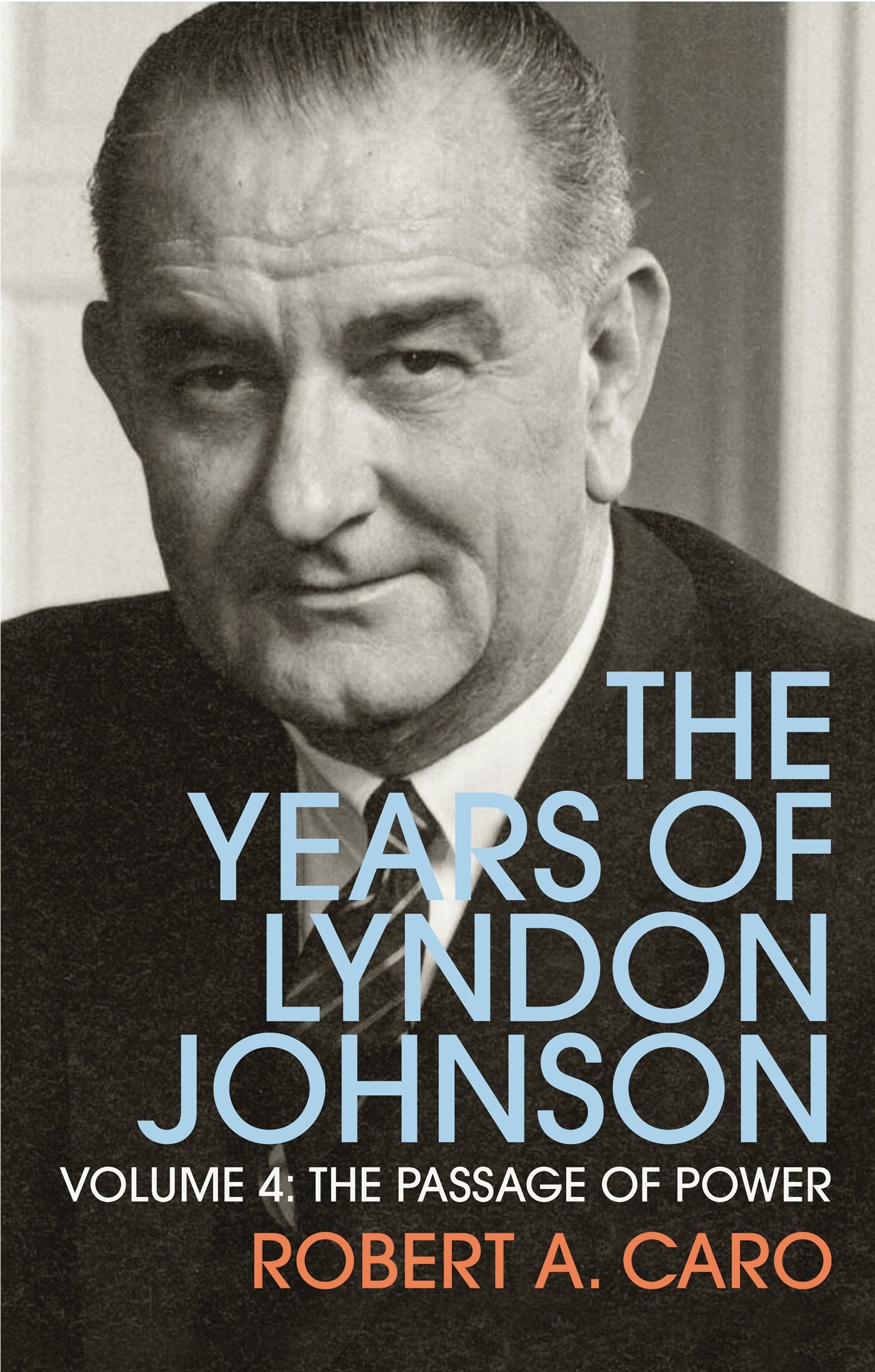
The Passage of Power, LBJ IV!!!!!
Major legislation signed
- 1963: Clean Air Act of 1963[269]
- 1963: Higher Education Facilities Act of 1963[270][271]
- 1963: Vocational Education Act of 1963[272]
- 1964: Civil Rights Act of 1964
- 1964: Urban Mass Transportation Act of 1964
- 1964: Wilderness Act
- 1964: Nurse Training Act of 1964[273]
- 1964: Food Stamp Act of 1964
- 1964: Economic Opportunity Act
- 1964: Housing Act of 1964[274]
- 1965: Higher Education Act of 1965
- 1965: Older Americans Act
- 1965: Coinage Act of 1965
- 1965: Social Security Act of 1965
- 1965: Voting Rights Act of 1965
- 1965: Immigration and Nationality Services Act of 1965
- 1966: Animal Welfare Act of 1966
- 1966: Freedom of Information Act (FOIA)
- 1967: Age Discrimination in Employment Act[275]
- 1967: Public Broadcasting Act of 1967
- 1968: Architectural Barriers Act of 1968
- 1968: Bilingual Education Act
- 1968: Civil Rights Act of 1968
- 1968: Gun Control Act of 1968
Bernstein, Irving (1996). Guns or Butter: The Presidency of Lyndon Johnson
Dallek, Robert (1998). Flawed Giant: Lyndon Johnson and His Times, 1961–1973
Woods, Randall (2006). LBJ: Architect of American Ambition
LBJ IV, pg. 15
"But the story of Lyndon Johnson’s transition is a story not only of difficulties he faced but how he surmounted them.
He not only broke the congressional logjam, he broke it up fast, and he broke it up on civil rights."
" his championing of them was regarded by most liberals as mere political opportunism: an attempt to lessen northern opposition to his presidential candidacy.
But although the cliché says that power always corrupts, what is seldom said, but what is equally true, is that power always reveals. When a man is climbing, trying to persuade others to give him power, concealment is necessary: to hide traits that might make others reluctant to give him power, to hide also what he wants to do with that power; if men recognized the traits or realized the aims, they might refuse to give him what he wants. But as a man obtains more power, camouflage is less necessary.
The curtain begins to rise. The revealing begins. When Lyndon Johnson had accumulated enough power to do something—a small something—for civil rights in the Senate, he had done it, inadequate though it may have been. Now, suddenly, he had a lot more power, and it didn’t take him long to reveal at least part of what he wanted to do with it. On the evening of November 26, the advisers gathered around the dining room table in his home to draft the speech he was to deliver the following day to a joint session of Congress were arguing about the amount of emphasis to be given to civil rights in that speech, his first major address as President. As Johnson sat silently listening, most of these advisers were warning that he must not emphasize the subject because it would antagonize the southerners who controlled Congress, and whose support he would need for the rest of his presidency—and because a civil rights bill had no chance of passage anyway."
"IN HIS SPEECH the next day, sympathy for the martyred President was enlisted to advance the cause, as was America’s desire for continuity, for stability, for reassurance that the government was holding to a firm course despite the loss of the man who had sat at its head. "
LBJ IV, pg. 23
"Strategy was necessary, too, a strategy on the grand scale, and, as will be seen, Johnson had one, a brilliant overview of a means of getting a civil rights bill passed, that he had urged on Kennedy, only to be ignored. As he had demonstrated in the Senate, moreover, it was not only strategy but tactics of which he was a master. Identifying and throwing his weight behind a seldom-used procedural lever—perhaps the only lever that could have worked—within a month after he had taken office he had broken the civil rights bill free of the congressional logjam. The bill wouldn’t be passed until 1964. It would be passed then only after a half year of struggle (whose heroes included not only liberal congressmen and senators, but the men, women and children who marched and protested, and who, many of them, were beaten and tortured—and, some of them, murdered—on the streets of the South. But it was a struggle whose strategy and day-by-day tactics were laid out and directed by him, and by the end of that first month it was at least on the road to passage."
"To watch Lyndon Johnson deal with Congress during the transition—to watch him break the unbreakable conservative coalition—is to see a President fighting not merely with passion and determination but with something more: with a particular talent, a talent for winning the passage of legislation (in this case legislation that would write into the books of law a measure of justice for millions of people to whom justice had been too long denied) that was more than talent, that was a gift, and a very rare one. To watch Lyndon Johnson during the transition is to see political genius in action.
He handled all the problems—the Kennedy men’s antipathy, the Kennedy brother’s hatred, the rumors over the assassination that, had they not been defused, might have escalated into international crisis—with the same sureness of touch. If the story of the five years is a story of failure, the story of the seven weeks is a story of what rose out of failure: triumph"
"The transition period covered in this book is particularly well suited to that purpose, for a way to gain insight into the most fundamental realities of any form of power is to observe it during its moments of deepest crisis, during its most intense struggles, when, under maximum stress, its every resource must be brought to bear—with the undiluted pragmatism born of absolute necessity—if the challenges facing it are to be met. It is at such moments that every one of those resources, every component of that power, is not only visible but, being used to its utmost, can be observed in all its facets. "
LBJ IV, pg. 37
"orders that would include details of each delegate’s political, personal and financial situation, and then the follow-up calls from Johnson—the calls, often in the middle of the night, in which he did not bother to identify himself but simply began, as soon as the telephone receiver was picked up, to ask questions, demand answers (Had this been done? Had that been done? Why hadn’t more been done?) and to give new assignments.'
"He had to start immediately making trips to states that would not hold primaries as well as to those that did, meeting the men who would select and, in some cases, control the delegates who would cast votes at the convention; he had to establish personal relationships with them—personal and other kinds: had to find out what they wanted, what promises (of positions in a new presidential Administration, for themselves or for their allies; of rewards even more pragmatic) would enlist their support; what issues they cared about, cared about deeply enough that a candidate’s position on them would be a decisive factor in whether or not they supported him."
"And, Rowe said, it was important to start doing that, too, as soon as possible: to lock up delegates before they were locked up by someone else."
LBJ IV, pg. 39
"He would pick up plenty of non-southern support without running around the country, he said. He would get that support right out of Washington. For one thing, he had Mr. Sam. The Speaker, he said, had an awful lot of representatives who owed him favors and who wanted favors from him. And he himself, he said, had his senators. He could count on them,"
"Let the other candidates run around the country, he said. Since none of them were particularly strong, they would kill each other off in the primaries. None of them had a chance of coming into the convention with anything near the necessary 761 votes. The convention would therefore be deadlocked, he said—and then the party would turn to him, for in the event of a deadlock, the nomination would be decided by the party’s bosses. They wanted a winner"
"“The Senate is already full of presidential candidates. If I really get into this thing, they’ll gang up on me and chop me up as Leader so that I’ll be disqualified for the nomination.” “Speculation [over whether he is a candidate] merely adds to the burden of his leadership,” John Steele of Time magazine explained to his editors on March 4, 1958, in a memo following a conversation with Johnson. But the validity, these men felt, was only to a point. For one thing, Johnson’s belief that senators (and members of Rayburn’s House) would control delegations had long been disproved. "
"W. H. Lawrence was to point out in the New York Times that for decades, “the Congresional [sic] bloc has not been dominant in either party’s national conventions.… In convention delegations, governors—enjoying state-wide patronage and constantly on the job at home—usually exercise much more influence than do Senators and Representatives.”"