Cult Icon
2585 replies · 37574 views

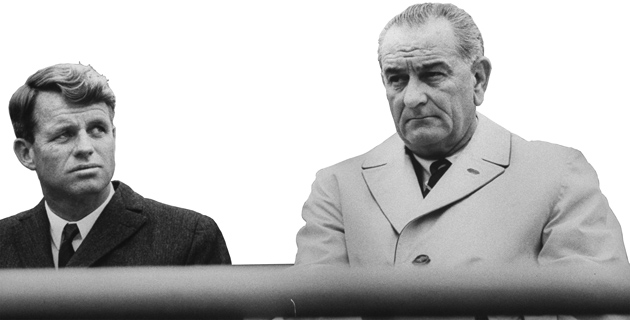

- "Guns or Butter", a book about his presidency argues that LBJ was the most effective legislator in US history, followed closely by FDR. Filling up the big 3 is Woodrow Wilson.
-"Johnson possessed a first-class mind, perhaps at the genius level. This
included a phenomenal memory and a large vocabulary. George Reedy, who
understood him very well, wrote, "The Johnson IQ took a back seat to
very few others—perhaps even to none. His mind was magnificent—fast,
penetrating, resourceful." Further, "he had the most superbly developed
sense of timing in the whole history of American politics." He had an uncanny
ability to foresee future events and their impact on particular senators.
"He could predict votes other senators did not even know they were
going to cast." White House aide Lee White stressed his "singlemindedness."
"He keeps his eye on that damned bull's eye all the time." In
the debate over the 1957 Civil Rights Act a question of great intricacy under
the common law arose—the distinction between civil and criminal contempt.
Johnson took a few law books home one evening and the next day,
according to Dean Acheson, one of the nation's top lawyers who was helping
Johnson with the amendments, was competent to argue the point before
any court in the U.S. Intellectually, Acheson said, it was "awe-inspiring."
When he became President, Johnson had virtually no understanding of the
federal budget. After evening and weekend meetings with Kermit Gordon,
his budget director, he attained mastery of the subject.
But much of this intellectual power was piddled away. "He simply
could not see a concept," Reedy wrote, "without an immediate pragmatic
objective." Because of his marginal education and his refusal to read anything
not directly related to his job, Johnson was unable to link his brilliance
to a broad range of knowledge. Thus, he often perceived only half of
a problem. Put another way, he was extremely bright but lacked wisdom"
"He was obsessed with politics and cared about almost nothing else—
literature, history, art, music, sports."
"No other President except Nixon was so obsessed with secrecy. He did
not want anyone to know what he was doing or intended to do until he
alone made the announcement. He lectured, threatened, and berated his
aides to protect his cocoon of secrecy. Yet he talked incessantly and was an
incurable gossip. Smart reporters couk! sometimes figure out what he was
going to do simply by studying what he said."
"He was notorious for abusing his staff, for driving people to the verge of
exhaustion—and sometimes over the verge; for paying the lowest salaries
on Capitol Hill; for publicly humiliating his most loyal aides; for keeping
his office in a constant state of turmoil by playing games with reigning
male and female favorites. . . .
His manners were atrocious—not just slovenly but frequently calculated
to give offense. . . . He was a bully who would exercise merciless
sarcasm on people who could not fight back but could only take it. Most
important, he had no sense of loyalty. . . . To Johnson, loyalty was a oneway
street; all take on his part and all give on the part of everyone else—
his family, his friends, his supporters. . . .
Occasionally he would demonstrate his gratitude for extraordinary
services by a lavish gift—an expensive suit of clothes, an automobile, jewelry
for the women on his staff. The gift was always followed by an outpouring
of irrelevant abuse."
LBJ IV, pg. 54
" And while Johnson may have believed that his triumphs in the Senate had given him national recognition, men like Rowe and Corcoran knew that this belief was unfounded. Outside of Washington, people simply weren’t that interested in the Senate, didn’t even know what a Majority Leader did. As a Johnson ally explained to Walter Jenkins, “You can cross the Potomac River and get out in the country and those folks haven’t the slightest idea how legislation is brought up—they don’t even know that Lyndon Johnson has the power to schedule legislation.”"
" If he wouldn’t do that, there was a slim chance—very slim, but nonetheless a chance—that he might be able to demonstrate that he could connect with northern delegates by going to their states, meeting them, speaking at their meetings. And, of course, he had to meet, and make allies of, the bosses themselves, some of whom he had met only once or twice—if at all. "
"So the possibility of defeat—of humiliation—loomed before him larger than ever, and “If he didn’t try, he couldn’t fail.”
So he didn’t try."
"No assistant accompanied him as he walked down to the little clutch of journalists waiting for him in the well below his desk. He knew all the details himself: the intricacies of bills, not only major bills but minor ones, too; the number that each bill had been assigned on the Senate Calendar; where in the subcommittee or full committee approval process it stood at the moment; what new amendments had been added to the bill, or defeated, that day, and why they had been added or defeated; what the arguments on each side had been; when the bill would be brought to the floor for a vote.
And there was never any question of him making a slip and giving the journalists information he didn’t want them to have. “"
"And one of the key elements in Lyndon Johnson’s command of his world—the Senate world—was his decisiveness.
During the previous four years of his majority leadership (the situation would not be ended until a Democratic landslide in November, 1958) he was usually operating with a mere one-vote margin, and in a Senate in which both parties contained differing, hostile blocs, the vote on proposed measures was constantly shifting, changing; amendments that could alter the balance were constantly being introduced, so a Leader had to know the moment at which to allow (or not allow) an amendment, or the moment at which, if he called a bill to the floor, it would pass—to know the moment, and to seize the moment. Month after month, year after year, when those moments came, Lyndon Johnson knew them—and seized them, with a decisiveness so quick and firm that it obviously came naturally to him, that it was obvious that deciding—acting—was something he enjoyed doing, something that he had the will, the desire, the need to do."
"All through 1958, Johnson wavered between his yearning for the prize and his fear of being seen to yearn for it.
His explanations for not becoming an active candidate—for not traveling to other states to rally delegates and leaders to his cause—varied widely. "
LBJ IV pg. 72
*Lazy Show horses getting most of the 'glory' and recognition
"When, in January, 1957, another vacancy opened on Foreign Relations, Joe Kennedy importuned Lyndon Johnson to fill it with his son instead of Kefauver, “telling me that if I did, he’d never forget the favor for the rest of his life,” and Johnson agreed. Later, he would say that he had done so because “I kept picturing old Joe Kennedy sitting there with all that power and wealth feeling indebted to me for the rest of his life, and I sure liked that picture.”"
"As for Lyndon Johnson, his opinion was that the young senator from Massachusetts was a “playboy” and basically lazy. “He’s smart enough,” he told Bobby Baker at the time, “but he doesn’t like the grunt work.”"
"Lyndon Johnson did not regard John Kennedy as a threat; in fact, he felt he might be a useful asset: a southern presidential candidate—a candidate from Texas, for example—would need a running mate from the Northeast; it wouldn’t be a bad idea to build one up, particularly one who had a father as powerful as Jack Kennedy’s"
"The fact that, due to his father’s fame, his speeches attracted more attention than those of other senators did not lead to more respect for him among his colleagues, but to the opposite: senators liked to categorize their colleagues as either “work horses,” men who studied hearing transcripts and department reports, did the donkey work on committees behind closed doors, and really made the Senate work, and “show horses,” men in the Senate only for the publicity it could bring them. Kennedy was, in the opinion of the “Old Bulls” who ran the Senate, a prime example of the latter breed."
" While he did from time to time make some brilliant speech about something or other … he was not what you would call a really effective senator.… He had a couple of pretty good ideas that he talked about, but I don’t know that anything he ever really passed … was of great significance.”"
"“Kennedy was pathetic as a congressman and as a senator,” Johnson was to say. “He didn’t know how to address the Chair.” He was, he said on another occasion, “a young whippersnapper, malaria-ridden and yellow, sickly, sickly. He never said a word of importance in the Senate, and he never did a thing.”"
LBJ IV pg. 73
"When he stumbled over a word, “a quick, self-deprecating grin” would break over his face—and, a member of one audience remembers, it “could light up the room.” And there was, however much he stumbled over his words, “a winning sincerity” in his speeches.
" At one forum in which all the candidates spoke, the master of ceremonies, no friend to Kennedy and eager to emphasize that he was a rich man’s son, made a point of introducing each of the others as “a young fellow who came up the hard way.” Then it was Kennedy’s turn. “I seem to be the only person here tonight who didn’t come up the hard way,” he said—and suddenly there was the grin, and the audience roared with laughter, and that issue was dead. "
"The tough Boston pols who had been hired with the ambassador’s money started to realize that the ambassador’s son not only had quite a quick wit but could think on his feet—could think fast.
And sometimes there was something more than wit. "
"Jack Kennedy paused, and said in a slow, sad voice, “I think I know how all you mothers feel because my mother is a Gold Star Mother, too.”
Suddenly women were hurrying up to the platform to crowd around Jack Kennedy and wish him luck, coming up to try to touch him. “I had been to a lot of political talks in Charlestown but I never saw a reaction like this one,” Powers was to recall. “I heard those women saying to each other, ‘Isn’t he a wonderful boy, he reminds me so much of my own John, or my own Bob.’ They all had stars in their eyes. They didn’t want him to leave. It wasn’t so much what he said but the way he reached into the emotions of everyone.”"
When we came downstairs, I said, ‘You don’t feel good?’ And he said, ‘I feel great.’ … He never would admit that he felt the least bit tired or anything.”
LBJ IV pg. 83
* Lots of real life applications
" Jack Kennedy, and his father, and visiting politicians—and they were visiting from all over the United States—would pore over it, noting “potentially valuable contacts.”
And Jack Kennedy made the contacts—and turned contacts into allies—in person, crisscrossing the country again and again."
"AS DETERMINED AS HE WAS, and much better at running for the presidency than Johnson had thought possible.
One of Jack Kennedy’s most impressive characteristics was an ability to observe—and to generalize from his observations, to understand the implications of what he was seeing—no matter how hectic his pace might be: to “learn on the run,” as one of his aides would put it."
"“The Senate is not the place to run from”—that not only was being a United States senator not much of an advantage when it came to running for the presidency, it might even on balance be a disadvantage, and quite a considerable one at that.
While newspaper and magazine coverage of the Senate, of necessity consisting of hard-to-follow explanations of arcane legislative technicalities, didn’t translate into public interest in that body, and the benefit to a presidential candidate in being an active senator was therefore very limited, the liability inherent in such a role wasn’t limited at all. A senator was constantly being forced to take stands on controversial issues, and such stands antagonized one side or the other—which meant antagonizing individuals or groups whose support a senator needed if he wanted to be President."
" In the history of the United States, only one senator—Warren Gamaliel Harding in 1921—had ascended to the White House directly from the Senate, and Kennedy understood why: “No matter how you vote, somebody is made happy and somebody unhappy,” he explained. “If you vote against enough people, you are dead politically.”
"Jack Kennedy had the ability not only to “learn on the run” but also to act on what he learned, to act rationally, dispassionately, coldly. Spending time in the Senate was a drawback, so he would spend as little time as possible there: that meant not doing the job to which he had been elected. He would be criticized—for absenteeism, for shirking his duties. But he had calculated that, in terms of his presidential run, such criticism would be far outweighed by the benefits from campaigning across the country; it was a criticism that would have to be accepted—and he accepted it.
Not only was Kennedy learning who had what Theodore H. White calls the “pieces of power,” he was learning who didn’t have them—which meant that he was learning, firsthand, the hollowness behind Lyndon Johnson’s belief that the Old Bulls of the Senate ruled their home-state pastures. Politics was changing, the old-style organizations were no longer so dominant, and as part of the change, in every state younger men—in 1957, about Kennedy’s age: forty—were rising up on the political ladder, some still on the lower rungs, some just entering politics, many of them war veterans like himself; they identified with him, were willing to work for him. Kennedy organizations were being set up in many states; thousands of names were being indexed at Kennedy headquarters. “Johnson thinks the campaign is in Washington,” Kennedy said one day to Ted Sorensen. “It’s not. It’s out here.”"
LBJ IV pg. 90
*JFK- rose by family riches, celebrity and campaigning rather than any political achievements
"Brilliant though the content of the speeches that Jack Kennedy dictated during those six years may have been, however, audiences were less than impressed, because of the way he delivered them. Despite magical moments like the one with the Gold Star Mothers, most of his talks were still delivered much too fast, with his smiles so fleeting and mechanical that their brightness hardly registered, and his physical appearance—the gaunt cheeks, the stiffness with which he moved, the suits hanging too loosely—did not add to their effectiveness."
"The way he delivered his speeches changed, too. His suits now looked casual and debonair, made elegant by his bearing as much as by the fabric; only late in the day, when the press of the suit jacket had wilted and the jacket clung to his frame a little bit, would the outline of the brace be even faintly visible. And the right arm was coming up more and more, higher—to shoulder level, often—and the hand was jabbing forward more and more emphatically as he made his points. And there was something different about the way he was starting to hold his head: sometimes it would tilt a little to the right, and his chin would come up, and out: strong, self-assured. His voice, with its distinctive New England accent, had always sounded earnest; now it was becoming more emphatic; sometimes, in fact—not often but sometimes—it was starting to have quite a ring to it. Lyndon Johnson might still be clinging to the image of a frail, ineffectual Jack Kennedy, but, month by month, as Kennedy crisscrossed the country in 1957 and 1958, speech following speech, that picture was changing: the chin coming up more and more, not just confident but a bit cocky, combative, ready for any challenge; the hand, when he got carried away, often up above his shoulder now, the forefinger jabbing at the sky, the fist punching at the audience, then the hand reaching to the crowd, palm up in entreaty and exhortation. And if, after the speech or during a press conference, he got hostile questions, which were mostly about his Catholicism, the chin would cock up a little more, the gesture would be more emphatic, and he would answer with a mixture of sincerity and self-deprecatory humor that brought audiences over to his side. “I have never seen anybody in my life develop like Jack Kennedy did as a personality, and as a speaker, and as an attractive person, over the last seven, eight years of his life,” George Smathers was to say. “It was just a miracle transformation.”"
"“This man seeks the highest elective office in the world not primarily as a politician, but as a celebrity,” one wrote. Said New York Post columnist William V. Shannon: “There is a growing tendency on the part of Americans to ‘consume’ political figures in much the same sense we consume entertainment personalities on television and in the movies. "
"“His Senate career,” concludes one of his biographers, Robert Dallek, “produced no major legislation that contributed substantially to the national well-being.” Misgivings about his lack of accomplishments were drowned out by the ubiquity and attractiveness of his media appearances, however. By May of 1957, the nationally syndicated columnist Marquis Childs would write, “Seldom in the annals of this political capital has anyone risen as rapidly and as steadily in a presidential sweepstakes as Jack Kennedy.” The effect of his celebrity was evident even in the enclave that was home to many of the capital’s political elite."
" As he was making his farewells on the high stoop of the house, some of Alsop’s neighbors, looking out their windows, happened to see him. Opening the windows, they began to applaud. Lyndon Johnson had been visiting homes in Georgetown for almost a quarter of a century. No one had ever applauded him."
"There appeared to be every chance that Kennedy would not be able to win 761 delegates, and that, after a number of indecisive ballots, the convention would still be deadlocked, and the battle would move into the back rooms—where Johnson wanted it, where the decision would be made by the old bosses who were still put off by Kennedy’s youth, inexperience and religion. Johnson was sure he would win in these rooms, and he was not alone in that feeling. "
LBJ IV pg. 91
*changing major rules and defeating a lawsuit with phone calls to influential individuals, burying skeletons and help from his important criminal ally.
"“I still think you have a chance for the nomination, despite [the] obvious political handicaps both of us know you carry with you, if you would go after it in the way I have urged you should,” Rowe wrote. “You would have had a better chance a year ago than now, but it is still possible, however remote. But, as I said, and as you agreed, you have no chance whatsoever if you ‘wait.’ By ‘waiting’ I mean staying always in Washington and doing only a superb job as Leader.… I did not make the rules that must inevitably be followed to win the Presidential nomination.… But I know, as do you, that they must be followed"
"solving that problem required no more than a phone call—which he made to Ed Clark. The state’s “Secret Boss” took care of the matter in the Legislature: on April 20, 1959, over the violent objections of a little band of liberals, it passed a special act which preserved the two-office prohibition—except in the case of a candidate who had been nominated for both a statewide office (such as United States senator) and “for the office of president or vice president of the United States.”
"And when, later, a lawsuit was filed challenging the constitutionality of this “Johnson for President” bill, Johnson simply made another call to Clark, this time asking him to bring to the Johnson Ranch a list of lawyers who could defend the suit. Clark watched Johnson’s big thumb move down the list, as slowly as it moved down Senate tally sheets, pausing as he considered the pros and cons of each name, until he got to “Jaworski”—Leon Jaworski, a respected Houston attorney who had two additional qualifications: first, as Johnson put it to Clark, that “He’s never been mixed up with Brown & Root”; second, that he was a friend of the state’s senior senator, Tom Connally, whose son, United States District Court judge Ben Connally, would probably be presiding over the case. “Will Leon Jaworski take this suit?” Johnson asked Clark. “I said Yes. You don’t even have to call him. I’ll take care of that.” (The suit never reached Ben Connally’s court; it was dismissed at a lower level.)"
"The other problem required a lot of phone calls, and delicate ones, since they involved a figure from Johnson’s past whom he had been hoping to keep in the past"
He needed a lawyer with very good Washington credentials, and, with federal prosecutors having seized his assets, he had run out of funds with which to hire one. Johnson had another incentive to help: his fear, as Ed Clark’s law partner Donald Thomas explains, that Parr might decide to talk publicly about 1948.
LBJ IV pg. 95
"Part of his strategy for obtaining the nomination was based on invalid assumptions—assumptions explained by the fact that he had lived so much of his life in Washington, where the Senate was a focus of intense interest, senators figures of power, and he, as the Senate’s Majority Leader, a cynosure of attention, his remarkably successful maneuvers through the arcane thickets of Senate rules and precedents chronicled in detail in the Washington Post and the Washington Star, marveled at during Georgetown dinner parties. He assumed that senators could deliver their state delegations to him, and that his announcement that Senate business required him to forgo campaigning would be understood, indeed hailed, by the country as proof of his indispensable devotion to the national welfare."
"into the back rooms (the “smoke-filled rooms” of political legend) that were the domain of the big-state bosses.
It was in these rooms, from these men, that Lyndon Johnson indeed had his best chance of obtaining the nomination. He would be negotiating with them—and he was of course a great negotiator—meeting alone with one or another of them: the greatest salesman, selling himself. Lyndon Johnson’s confidence that he would get what he wanted from any man if he was only able to spend time alone with him had not, in the major episodes of his life, often proved to be overconfidence. He would be negotiating, furthermore, with men who talked the idiom of hard, tough, pragmatic politics, the language not of the Senate floor but of the Senate cloakroom—Lyndon Johnson language. “It is the politician’s task to pass legislation, not to sit around saying principled things,”
" In the conversation of these men, “principled things” were not a prominent motif; what they talked about was winning.
For this strategy of the back rooms to succeed, however, there was a sine qua non. To these men who wanted to win, he had to prove that he could do so, had to demonstrate to the northern bosses that he could carry states outside the South in November."
"He had to enter some non-southern primaries—Indiana and West Virginia, for example—and do well in them. If he didn’t show these men that he was a winner, no sales talk would help."
"“For eighty-two years men talked and talked—and did nothing—about civil rights legislation,” the governor said. “But it was a Democratic Congress which in 1957 passed the first civil rights bill since Reconstruction.” It was a Democratic Congress that had in 1956 and 1957 passed disability insurance, minimum wage, public housing, and public works measures. “Lyndon Johnson is … the man who guided through the Congress the programs upon which the Democratic Party rests its case with the people.”"
LBJ IV pg. 103
"His excuse for declining invitations was the press of Senate business, but the Senate adjourned for the year in August; five months were open before the next session. Although he had accepted invitations for events during these months, again and again he pulled back as the day approached, often at the last minute telling his staff that he wouldn’t go, to make some excuse; often he blamed the staff, saying he had never agreed to go, even though of course he had—in a pattern that became so familiar that his aides grew to dread accepting an invitation, since they knew that later, after the invitations had been printed and mailed and all arrangements made, they would probably have to call the event’s organizers and tell them the featured speaker wouldn’t be there. Jim Rowe saw a man being “torn”—“tortured, almost”—between his desire for something, and his desire not to be seen to be desiring it."
Locking it up, however, meant courting the western delegates as individuals. To find out what issues were important to a man or what pragmatic considerations—a federal job, a contract, cash—a man really wanted, it was necessary to talk to him in person. And while in the western states there were no statewide bosses, in many cases four or five delegates might be controlled by, or subject to the persuasion of, some local political leader or businessman. Johnson had to learn the identity of the local leaders who held these “pieces of power,” and bring them, too, to his side."
"But learning would require him to travel to the different states, meet the delegates—he would have to, in short, campaign. Unless he did that, his strategy had no hope of success. But campaigning would have meant admitting that he was trying—and in 1959 he still wouldn’t, still seemingly couldn’t, admit that."
"DENYING IN PUBLIC that one was a candidate was, naturally, par for the political course; in Johnson’s case, however, the denials were made, with seeming conviction, even to men who had worked with him a long time.
Though to these men, his maneuvers in Texas were definitive proof (not that they needed proof) that he was a candidate, he kept refusing to admit that to them, refusing even to say that he would eventually, at the proper time, become a candidate."
" On the subject of primaries, he was equally unequivocal. Primaries produce an unambiguous, undeniable result: there is a winner—and there are losers. Johnson was adamant: he wouldn’t enter any primaries."
LBJ IV pg. 109

"" When he resigned in July of that year, it wasn’t because he disapproved of McCarthy’s tactics, but because of a feud with chief counsel Roy Cohn—whose job he wanted, and didn’t get, and with whom he almost came to blows—and because he didn’t get a promotion on the committee staff.""
"where they found themselves confronted by a young man with icy blue eyes staring, glaring, at them with an unnerving intensity. As he questioned them, hunching forward over the committee dais as if he wanted to get at them physically, his right arm would jab out with each question in a movement reminiscent of his brother’s when his brother was giving a speech, except that Jack Kennedy’s hand was open for emphasis and entreaty; Robert Kennedy’s hand was balled up; sometimes the thumb stuck up from it, sometimes the forefinger pointed out, but essentially it was a fist."
" Kennedy never stopped trying to influence the public against Hoffa, through reports of his committee, a steady stream of inflammatory press releases and the use of “friendly reporters to propagate” the image of Hoffa that he himself saw; one reporter was given a key to the committee offices so that he could obtain information about Hoffa while Kennedy could deny he had leaked it. And when, in 1961, Kennedy would become attorney general, and had at his command, as the journalist Nick Thimmesch writes, “the full arsenal” of the government’s legal powers, he used them. Forming an elite “Get Hoffa” squad in the Justice Department, he launched an all-out campaign against the union leader, in which he also deployed the FBI and the Internal Revenue Service. At one time, fourteen separate grand juries were probing the Teamsters. Protests over Kennedy’s tactics came not just from congressmen and senators of both parties who felt that Hoffa’s corruption and brutality did not justify the tactics that Kennedy was using against him, but from the American Civil Liberties Union. Kennedy never changed them, and, finally, in 1964, he got a conviction. It had taken seven years—but he had gotten it. “When Bobby hates you, you stay hated,” Joe Kennedy told a friend. And he hated Lyndon Johnson"
" Bobby Kennedy knew which young people mattered, and how to win to his brother’s cause the ones who mattered, how little courtesies could mean a lot. “It really struck me that it wasn’t the issues which matter. It was the friendships."
LBJ IV pg. 128
"Johnson’s reaction “astonished” Dutton. “Brown was a Governor, and here Johnson was just tongue-lashing him,” he says. “He towered … his desk was higher; it was on a platform. ‘Don’t you ever say I’m not electable! What do you know about national politics?’ ”
The reaction cost Johnson any chance of Brown’s support. "
" “However much affection Russell might feel for Lyndon Johnson, the overriding reason that Russell wanted him to become President was to protect the interests of the South; when Johnson’s interests collided with those interests, it was the South’s, not Johnson’s, that would be protected,”"
"A Johnson proposal to bypass the southern-controlled Judiciary Committee and bring the bill to the floor by adding its provisions to a House measure on an unrelated topic caused the first rupture in the eleven-year alliance of the two legislative titans; Russell called the move “a lynching of orderly procedure in the Senate.”
“It wasn’t that he was a conservative or a radical or anything else; it was simply that he was trying to be all things to all people.” “So long as he leaves them in ignorance, they find it easy to accept the popular liberal characterization of him as a representative of a Texas dominated by segregationists and oil barons.”
"When Lyndon Johnson was fighting hard for something—and he was fighting hard now, even if only behind the scenes (“It was like the old days,” Ed Clark says; “I could set my watch by getting a call from him at six o’clock in the morning”)—an aspect of the determination he always displayed during such efforts was conviction, a seemingly total belief in what he was fighting for. He felt that victory required belief. "
“What convinces is conviction. You simply have to believe in the argument you are advancing; if you don’t, you’re as good as dead. The other person will sense that something isn’t there.”
"And then, Wright was to recall, he saw Jack Kennedy speak for the first time. “He spoke for about eight minutes,” and “that was all he needed. When he sat down he had that crowd in the palm of his hand. He had the gift of leaving them wanting more. I saw the Kennedy magic then that I had not really appreciated.”"
"Later, Johnson “told Walter Jenkins the man was ‘a defeatist,’ and soon he was no longer” on the payroll. “Consequently, fewer and fewer people who had Johnson’s ear told him the truth as they saw it.”"
LBJ IV pg. 161
*JFK, with little political achievements/record, did not have the political enemies/liabilities of LBJ and could craft his own image/positions, helped by his splendid money and campaign organization. Like Obama, a no-body that could create celebrity and manufacture a new self out of thin air.
*JFK beat LBJ for the presidential nomination with a massive landslide- by pure celebrity and LBJ's sloth (driven by fear of failure) in campaigning.
"“Tip” O’Neill was only in his eighth year in the House, he was, as a protégé of Majority Leader John W. McCormack of Massachusetts, a rising figure there—he would one day be Speaker, and was already known as a congressman with connections beyond Massachusetts’ borders."
"It was after West Virginia that Johnson said to Jim Rowe, “How the hell does Joe Kennedy move money around like that?” And, like the rest of Johnson’s efforts, the money card was played too late. Television documentaries and telethons have to be produced in advance to be effective, local organizations require time to be set up and financed. A last-minute half-hour statewide telephone call-in telethon for Humphrey, staged with almost no preparation at all, was embarrassing: authentic, unscreened questions put the candidate on the defensive."
His days, as one reporter wrote, “were all 18-hour days.”
And for half an hour, until the plane touched down, Johnson kept reminding the reporter that it was leadership that was needed, and that he was the Senate’s Leader, that he had proven he could lead."
South Dakota’s governor, Ralph Herseth, had come to the airport, and Johnson had “bounded out of the plane” to meet him, and as the journalists walked past on the tarmac, he was pumping the governor’s hand, talking away, with the only expression on his face a broad, confident smile; if Lyndon Johnson was tired, he wasn’t letting anyone know it."
ON CAPITOL HILL, Johnson held a lot of cards, and now he was playing them. In several states crucial to his presidential hopes, Senate seats were becoming vacant in 1960, and some of the Democrats running for them—Thorn Lord of New Jersey and Representative Lee Metcalf of Montana, for example—had been promised financial support by the Senate Democratic Campaign Committee. Now these candidates were told that that support would be rationed out in inverse proportion to their support of Kennedy. And not only cash but committee assignments were in Johnson’s hand."
Johnson and Rayburn were talking about a Congress they controlled. Rayburn’s “word is virtually law among Democrats in the House,” James Reston noted. Power over legislation senators and congressmen wanted—or needed, to satisfy demands of their constituents—was in the hands of the two Texans, and in the hands of the committee chairmen who wanted Johnson to get the nomination. With the new congressional schedule, Johnson and Rayburn would be holding this legislation over the heads of senators and representatives in Los Angeles; as James Reston wrote, “The theory … was that the two Texans would be able, by their influence over legislation in the recessed session, to induce forty or fifty delegates to support Mr. Johnson.”
Evans and Novak were to call the “audacious” maneuver “blatant political blackmail.”
"One issue he had stayed away from was health: for a candidate who had suffered a major heart attack, health wasn’t a sure winner. But now any card he held had to be played. A decade before, as the chief counsel of Johnson’s Preparedness Investigating Subcommittee, Donald Cook had impressed Johnson as a very sharp lawyer and investigator. Now he was president of the American Power Company, but at the end of June Johnson drafted him to investigate Jack Kennedy’s health.
Going directly to Frank Brough, who, as president of a pharmaceutical manufacturing company, “has,” as Cook was to tell Walter Jenkins, “a great many doctor contacts around the country,” Cook quickly struck pay dirt. “Brough told me about this Addison’s Disease,” he told Jenkins. “Kennedy … was treated for it in the Lahey Clinic in Boston.… I am told he not only had it but has it now and is receiving treatment for it.”
By the next day, Cook had the name of a doctor, Lewis Hurxthal, who he said had treated Kennedy for Addison’s disease "
LBJ IV pg. 236
"No Majority Leader in history had ever accumulated anything remotely comparable to the powers Johnson had accumulated; that was why he was able to run the Senate as no other Leader had run it. So long as the Democrats controlled the Senate, and the southern Democrats who controlled the Democratic Caucus (and the chairmanships of virtually all of the most powerful Senate committees) supported him, his power within the institution itself would remain solid; the Senate leadership would still be immensely more powerful than the position he was trading it in for. Should Kennedy win, on the other hand, Johnson’s position in relation to the world outside the Senate would be diminished both symbolically (he would no longer be the highest elected Democratic official in the country) and in a very concrete way as well: to the extent that there had been a Democratic legislative agenda during the past six years, he had had a major role, perhaps the major role, in setting it; now that agenda would be set by the White House: legislation—Democratic legislation—would be sent to the Senate for him to pass. “Although Johnson’s power emanated from the Senate, he had made the Senate felt across the land,” Evans and Novak wrote. “For the past half dozen years … he, more than any other single Democrat, spoke for his party.” Now, if Kennedy won, that would no longer be the case. And if he proved insufficiently compliant with a Democratic President, that President could always move against him. An antagonistic President of his own party could make life difficult for any Majority Leader."
Furthermore, for a Texan who had only one goal, that route had some obvious advantages over the Senate leadership. The vice presidency might be a meaningless position, a joke position, when looked at as it was generally looked at: in terms of itself. When looked at as a means of becoming President, it took on a different aspect. For one thing, a Vice President was a national figure. As a Leader raised to Senate power by the South, Johnson had little choice but to represent southern interests, to be a sectional leader. He would continue to be, as he had been, bound to the South (just as—as a senator from Texas—he was bound to Texas oil interests, which were also unpopular in the rest of the country). To realize his great dream, those southern and Texas ties needed to be cut.
As Vice President, those ties would be cut, to a considerable extent. He would no longer have to represent Texas: the national Administration of which he would be a part represented not a state but a country. He would no longer have to represent the South—the South would be only one section of the country. His positions on issues could be those of an official representing the whole country—positions that would help, rather than hurt, in a future bid for the presidency. In addition, a Vice President was the logical candidate to succeed the President when his four or eight years in office ended, the natural heir to the presidency."
if Kennedy lost, “you’re going to be blamed—because they’ll try to ensure that you’ll be blamed. And [therefore] you’ll have a large segment of the party against you.” If Johnson ever wanted to try for the nomination again, that would make it even harder than it otherwise would be.
" and Lawrence, anxious to have Johnson on the ticket because he felt southern electoral votes were necessary for victory,"
And none of them would ever forget Sam Rayburn in that moment. He was old, and he was blind, and, as would soon become apparent, he was very, very ill. "
" He seemed, in fact, quite at ease; he looked, as the Washington Post put it, “as though he had spent the day at the beach.”"
"The labor delegates said that they, in combination with civil rights and other liberal groups, would nominate their own candidate for the vice presidency to oppose Johnson that evening. “Bobby was shaken.”
Jack Kennedy relied on his brother, trusted him, needed him, but he didn’t always tell him everything he was thinking or doing.”3 More than one Kennedy adviser arrives at the same conclusion. Fred Dutton, for one, says, “I always suspected that Jack didn’t tell Bobby everything about LBJ because Jack figured Bobby would try to stop him.”
It may be that Jack Kennedy didn’t always tell anyone everything he was thinking or doing. "
The efficiency of this technique maximized its impact: during the five days that the LBJ Special chugged through the Southland, the incredible number of 1,247 dignitaries—governors, senators, congressmen, state legislators, mayors, councilmen, sheriffs, bankers, businessmen and other pillars of local communities—were entertained in that parlor car. And maximizing its impact also was the unique ability of its host; after interviewing a group of local officials who had just descended from the train, McGrory summarized their comments: “In explaining the political realities, he remains peerless.”
"“Despite Johnson’s signals, few senators [had anticipated] the extent of his power grab.” "
" Johnson wanted a large staff—a very large one; he had had some fifty persons working for him as Senate Majority Leader, and he seems to have envisioned keeping most of them as Vice President. "
LBJ IV pg. 245
*Applications to life: power grabs early on in the relationship solidify a destruction of trust building and a loss of power to the inferior
*As punishment for the attempted power grab, JFK denied LBJ and gave LBJ two worthless posts
Seward parallel, but since Seward’s letter to Lincoln—actually a memo sent by Secretary of State William H. Seward shortly after Lincoln’s inauguration—had sought extraordinary power for himself at the President’s expense (it would have made him, an historian wrote, the equivalent of “a prime minster, with Lincoln the figurehead”), Reedy knew that the Kennedy official had been referring to Johnson’s proposed executive order."
“Had Mr. Lincoln been an envious or resentful man, he could not have wished for a better occasion to put a rival under his feet,” even, perhaps, by dismissing him, but instead he demonstrated an “unselfish magnanimity” which was “the central marvel of the whole affair.” John Fitzgerald Kennedy had handled Johnson’s power grab the same way, as Reedy saw: thanks to Kennedy, he was to say, “the whole thing was lost in charitable silence.” The President had handled it magnanimously and casually—as if there had been no reason to take it seriously."
"At the end of all his scheming and maneuvering, what he got—the only new responsibilities Kennedy gave him—were the chairmanships of two committees"
"the second—of the Committee on Equal Employment Opportunity—carried with it a threat of damage to his ambitions. If you accept the post, Rowe wrote him in alarm, “You will become the target of … the ‘advanced’ liberals because you are not doing everything and also the target of the southerners every time you try to do something even minor.… It will be impossible to satisfy either group no matter what you do.”"
the misreading of John F. Kennedy by Lyndon Johnson was over, too. He had read him now, all the way through: The younger man was a lot smarter than Johnson had thought he was—and a lot tougher, too. He was always, without exception, whatever the provocation, the gentleman—but a very tough gentleman. Nothing could have been more gracious than the way he had handled Johnson’s requests—and nothing could have been more unyielding. Some months afterward, Johnson would be talking off the record to Russell Baker of the New York Times, and, Baker was to write years later, “there was a tribute [from Johnson] to the steely strength with which President Kennedy dispatched his enemies”—a tribute couched in rather remarkable words: Johnson described Kennedy “when he looks you straight in the eye and puts that knife into you without flinching.”
"HOW MUCH OF WHAT FOLLOWED can be laid at that young man’s door is obscured by his manners, his graciousness and his opacity."
LBJ IV pg. 246
“liked Johnson personally, valued his counsel on questions of legislation and public opinion and was determined that, as Vice President, Johnson should experience the full respect and dignity of the office. He took every care to keep Johnson fully informed. He made sure he was at major meetings and ceremonies. Nor would he tolerate from his staff the slightest disparagement of the Vice President.”
"“I can’t afford to have my Vice President, who knows every reporter in Washington, going around saying we’re all screwed up,” he told his appointments secretary, Ken O’Donnell, “so we’re going to keep him happy.” Telling O’Donnell that that was his assignment—that he was, as O’Donnell puts it, “in charge of the care and feeding of Lyndon Johnson”—he told him to handle the job with sensitivity. “Lyndon Johnson was … the number one Democrat in the United States elected by us [Democratic senators] to be our leader. I’m President of the United States. He doesn’t even like that. He thinks he’s ten times more important than I am"
"But he thinks you’re nothing but a clerk. Just keep that right in your mind. You have never been elected to anything by anybody, and you are dealing with a very insecure, sensitive man with a huge ego. I want you literally to kiss his fanny from one end of Washington to the other.”
Johnson was insatiable,” Schlesinger said in reporting this conversation. For him, “no amount of consideration would have been enough.”
LBJ IV pg. 250
*Social exclusion- Kennedy did not find Johnson to be loyal enough to be his man
"Some, at least in the early days of the Kennedy Administration, were the result of Johnson’s attempts to create an image of himself as one of its key players, a valued adviser (more than an adviser: in a way a partner of this younger, less experienced man); of his attempts to push himself forward into that position; and of the fact that he was dealing with a man who didn’t like to be pushed—and who wasn’t going to be pushed, certainly not by someone he didn’t need anymore."
"He (Kennedy) hadn’t wanted to walk into the meeting with Johnson beside him. And when he walked into the meeting, Johnson hadn’t been beside him."
"That scene—Johnson lecturing and jabbing, Kennedy “fiddling with papers”—“was one that I was going to see many, many, many times whenever Johnson was in that office alone with Mr. Kennedy,” "
"During the entire year of 1961, Mrs. Lincoln was to calculate from her diary entries, Johnson spent a total of ten hours and nineteen minutes alone with Kennedy—less than an hour per month. During that year, he had breakfast alone with the President twice. He had had more breakfasts, many more breakfasts, alone with a President—President Roosevelt—when he had been a junior congressman twenty years before."
"And if that incident was a response to Johnson’s pushing, there were others that couldn’t be laid at the Vice President’s door.
Kennedy’s instructions that Johnson be invited to the large formal meetings of the Cabinet, the National Security Council and the legislative leaders were followed, at least for a while. In the Kennedy White House, however, as Theodore Sorensen was to admit, it was not in such formal meetings but in “the smaller and more informal meetings” of presidential intimates that “the final decisions were often made”—and to such meetings, from the early days of the Kennedy presidency, Kennedy quite often “did not invite him.”
"Johnson’s exclusion was particularly striking in the area in which he had expected to play his most significant role: guiding the Kennedy Administration’s program through Congress. Lawrence O’Brien was put in charge of that task"
Within a few days Johnson realized that he wasn’t the man whom senators and representatives were calling when they were negotiating about something with the Administration, or asking it for some favor.
There were, of course, some strategic explanations for Johnson’s exclusion. One was his reputation, the aura of legislative genius that surrounded him in the eyes of newsmen who had watched his mastery of the Senate. One of the new President’s characteristics was an affection for the spotlight—and a disinclination to share it. To the suggestion that the renowned poet Robert Frost be given a role in the inauguration, he had responded with approval—and caution. The role should not be a speech, he said. “Frost is a master of words. His remarks will detract from my inaugural address if we’re not careful. Why not have him read a poem—something that won’t put him in competition with me?”
Johnson was a master of something, too—legislative tactics—and, as one historian writes, Kennedy “did not want [Johnson] managing [the Administration’s] legislative program and creating the impression that the President was following the lead of his Vice President, a more experienced legislator.” Another explanation was Johnson’s ego, which, as O’Brien aide Myer Feldman puts it, Kennedy felt “was so great it might handicap the Administration.” Once Lyndon Johnson was again roaming free on Capitol Hill, his native habitat, there would be no controlling him. “If he had been unleashed he would have found it hard to refrain from running the whole show,” his aide Harry McPherson says.Considerations of policy may also have played a role. “If Kennedy had allowed Johnson to conduct his congressional relations, he would in effect have made the Vice President the judge of what was legislatively feasible and therefore lost control over his own program,” Arthur Schlesinger wrote. “This was something no sensible President would do.
LBJ IV pg. 250
On Sundays, O’Brien and his wife, Elva, invited senators, representatives and journalists to mingle with Administration insiders at brunch at their house in Georgetown. At one time—during his twelve years in the Senate, in fact, and, indeed, even before that, during his later years in the House—Lyndon Johnson’s house had been the place to be on Sundays if you wanted to know what was really going on on Capitol Hill.
Not anymore"
AND ON THOSE OCCASIONS WHEN, as at one of the Tuesday breakfasts, he offered his opinion on legislative matters, it was not treated with particular respect. “He was so resentful of being at the breakfasts with … Mansfield and Hubert Humphrey, who was quite voluble, speaking on every issue,” says O’Donnell. “And they sort of all treated Lyndon like he was one of them and he didn’t want to be treated like he was one of them. If he did say something, they’d say, ‘I don’t think you’re right. You haven’t been up there lately.’ ” These were men who had once shown him deference, and more than deference. Once, after Johnson had given Hubert Humphrey an order on the Senate floor and he hadn’t moved fast enough to suit the Leader, Johnson, snarling “Get goin’ now!,” had kicked him—hard—in the shin to speed him on his way, and Humphrey had accepted the kick without complaint, had even pulled up his pant leg the next day to proudly show a reporter the scar. Now Humphrey talked back to him, told him he was wrong."
"That was the picture of Lyndon Johnson at social as well as political gatherings; at dinner parties, he wanted to monopolize the conversation; if other guests persisted in talking, he would close his eyes and go to sleep, or at least appear to, until a gap in the conversation let him start talking again.
And if the senators didn’t listen to him, certainly the bright young men of the Administration who attended the leaders’ breakfasts—O’Donnell, O’Brien and O’Brien’s aides Feldman and White—didn’t. Says an occasional attendee, Wilbur Mills, chairman of the House Ways and Means Committee, “The President had more or less shelved the Vice President, … turned him out to pasture.” The congressional leaders saw that the Administration’s men didn’t put much stock in his opinions. So why should they? No one listened to him. “The greatest legislative prestidigitator of his time” had been stripped of any opportunity to use his sleight of hand.
In status-conscious Washington, it did not take long for such a dramatic change to be noted. By March 19, Tom Wicker of the New York Times was writing that “Those who have watched his giant strides about Washington this past decade” are “puzzled.” The Administration has kept this “proud and forceful figure … out of sight and out of print.”
Johnson’s response to the new position in which he found himself was to hardly talk at all at Cabinet, National Security Council and legislative leaders’ meetings—even when directly invited by the President. "
"With Kennedy, however, the tactic had no success at all. “I cannot stand Johnson’s damn long face,” the President told his buddy Smathers. “He just comes in, sits at the Cabinet meetings with his face all screwed up, never says anything. He looks so sad.…"
LBJ IV pg. 260
*Kennedy's reaction to the Bay of Pigs Fiasco was to take full responsibility; the reason being that he did not want scapegoating to poison his organization and make his subordinates paranoid.
“There’s an old saying that victory has a hundred fathers and defeat is an orphan,” he said; not this defeat. “President Kennedy has stated from the beginning that as President he bears sole responsibility,”
"PART OF THE EXPLANATION for the attitude of President Kennedy and many members of the Kennedy Administration toward Lyndon Johnson was suspicion and fear—of this figure who for so long had loomed so large over their lives, as the Leader, as their most feared opponent in the fight for the presidential nomination: of what he might do, this master of politics, if they gave him the slightest opening. "
"“At least part of the problem in Johnson’s vice presidency was LBJ’s personality and lust for power. The more restless he got, the more suspicious of him Kennedy’s people became.”
Another part of the explanation was Johnson’s natural aggressiveness—which manifested itself to them in ways that confirmed their feelings that he was still trying to grab a bigger role in the Administration than they wanted him to have; that, as Evelyn Lincoln was to say, his “immediate thought was of his image,” not of the President’s."
A constant reminder of this was Johnson’s unending appeals, when the two men were traveling to the same city, to be allowed to fly with Kennedy on Air Force One, appeals that Mrs. Lincoln felt were being made so that he would be photographed getting out of the plane with the President, share in his spotlight. This “constant argument,” as Lincoln calls it, “cropped up every time the two men were going to make a joint appearance.”
"y coming into my office, Mr. Johnson was creating the image of working closely with Mr. Kennedy,” she was to write, especially if he was in her office “when any of the Cabinet men or other officials came in.” And by emerging from the President’s part of the White House when he walked by the journalists, he would give them the same impression. And she felt she understood why Johnson’s car would remain standing outside the West Wing all the time he was inside—as an advertisement that he was inside.'
"Feeling that “Johnson was a liability who would say or do things that would reflect badly on the Administration, he wanted to keep close reins on him”—and he did. He informed Johnson’s staff that all vice presidential speeches and statements had to be approved in advance by the White House. “He couldn’t issue a press release without it being cleared,” says Ashton Gonella. “Imagine if you had been king and then you had to clear everything you said.”
Clearance was required in other areas as well."
Johnson’s role, he said, should be “Salesman for the President’s program.”
" after several months Robert Kennedy realized that a bill important to him, one that he had expected to make its way smoothly through the House Judiciary Committee, was in fact making no progress at all. He asked Rayburn for an explanation—and got it. “That bill of yours will pass when Sarah Hughes gets appointed,” the Speaker said.
Bobby explained that she had been ruled too old for the job. “Sonny, everybody seems old to you,” Rayburn replied. Ms. Hughes’ appointment was announced the next day'
nce again, it involved Rayburn. Having to deal with the Speaker on his legislative program had made John Kennedy more aware than ever of his power; appointing his friend, the painter William Walton, to the chairmanship of the federal Fine Arts Commission, he had only one instruction for him: “Don’t get me crossways with Rayburn.” "
And he was aware also of how much Johnson needed the old man—and of how wary Johnson was of doing anything to irritate him. And when, suddenly, there was a possibility of a dispute between the two Texans, the President knew just what to do about it, and worked out with O’Donnell a scenario designed for Johnson’s maximum discomfiture."
LBJ IV pg. 264
"With little interest in Texas patronage—except for old friends who needed jobs—Rayburn had been allowing Johnson to clear all appointments for Texas (Kennedy had agreed that Johnson could do so), but he had an old friend who had been on the commission for years until he was removed by the Eisenhower Administration, and he wanted him back on it. "
"There had been years—eight years—when the young senator “could not get consideration for a bill until I went around and begged Lyndon Johnson.” How much had Jack Kennedy resented having to beg? Whatever the reasons for a personal edge in his dealings with Johnson, the edge, no matter how many historians and Kennedy aides deny its existence, was definitely there"
"“YOU’LL STILL HAVE THE SPEAKER,” John Connally had told Johnson in Los Angeles, advising him to accept the vice presidential nomination: as long as he had Rayburn behind him, he would have power in dealing with the Kennedys.
Now he no longer had the Speaker behind him. He no longer had the Senate behind him. He had no one behind him in Washington. “Was it worse for Johnson after Rayburn died?” the author once asked John Connally.
“Yes,” Connally replied.
LYNDON JOHNSON, WHO HAD DEVOTED all his life to the accumulation of power, possessed now no power at all, and as Vice President the only power he would ever possess was what the President might choose to give him. He understood that now: understood that it was imperative for him to remain in the President’s good graces."
"MATCHING THE GIFTS in extravagance was the deference. "