Cult Icon
2585 replies · 37576 views
LBJ IV pg. 638
Russell changed the subject and began talking about Lyndon Johnson. “He said that Lyndon Johnson was the most amazingly resourceful fellow, that he was a man who really understood power and how to use it,”
“You know,” Russell said, “we could have beaten John Kennedy on civil rights, but not Lyndon Johnson.”
But in 1963, the Organization, unchanged, was as powerful as ever. Voting by the newcomers hadn’t altered the pattern of politics in the state, because, in general, the newcomers couldn’t vote."
"“The Byrd Machine is the most urbane and genteel dictatorship in America.” But a dictatorship it was. Candidates for office—almost any office, from state legislator down to local school board trustee—would, if the senator approved of them, receive an endorsement known as the “nod.” Without the Byrd nod, it was all but impossible to win an election in Virginia. The state’s last nine governors had all received the nod. As had, of course, Howard Smith of the House Rules Committee. And candidates who tried to win without it encountered tactics that had earned the Organization a different nickname: “the Steamroller.” The Organization (or Steamroller) “runs the commonwealth as effectively as Prendergast ever ran Kansas City … though with much less noise,” Gunther observed. “Because of its control over practically every office, no matter how minor, it is quite possibly the single most powerful machine surviving in the whole United States.”"
"Byrd’s beloved thirty-five-year-old daughter, Westwood, died after a fall from her horse during a fox hunt. Rosemont was a two-hour drive from Washington, and heavy rain was falling on the day of the funeral. No other senators were planning to attend the services, but Johnson did, managing at the last minute to persuade another young senator, Warren Magnuson, to accompany him so he wouldn’t be alone. And, Johnson told Busby later that day, as he and Magnuson stood in the rain across the grave from the Byrd family, holding their hats in their hands, the only senators present, Byrd suddenly looked up and saw them. “He looked at us, and then he looked back at me,” Johnson told Busby. “I don’t know what that look meant, but I’ll bet … that was a very important look.”It was. Byrd’s administrative aide John (Jake) Carlton told Johnson that he was welcome to drop around to Byrd’s office when he had a problem he wanted to discuss. And Johnson used the privilege he had been given to make the impression he wanted to make on the courtly Virginian. He would always telephone ahead to Carlton for an appointment, but when he arrived at the office, even if Carlton said the senator was free and was expecting him and he could go right in, he wouldn’t do so, “wouldn’t walk right in even if I motioned to him that he could.” Instead, to emphasize that he wouldn’t even think of barging in, "
But by the time the conversation ended, he had been “struck by the enormous difference between Kennedy and Johnson.… Where Kennedy had been polite and sympathetic on all matters of basic principle, more often than not he had been evasive on action. Kennedy was not naïve, but as a legislator he was very green. He saw himself as being dry-eyed, realistic. In retrospect, I think that for all his talk about the art of the possible, he didn’t really know what was possible and what wasn’t in Congress.…
LBJ IV pg. 644 - Civil Rights Bill
“I’ll take care of the bill itself,” Young heard the President say, but he needed help with the petition. “We’ll all work on it. Everybody will have his assignment.… We’re on the same team.”
These black leaders had been fighting on the streets with, some of them, the tactics of the orator, and, some of them, with the tactics of the revolutionary. Sitting on the Oval Office couch, the long telephone wire stretching in front of their faces up from the telephone console on the coffee table to the receiver in Lyndon Johnson’s hand, they heard, in a Texas twang, a President fighting with the tactics of the legislator. To a legislator, what counts is votes. Not merely explaining to Martin Luther King the importance of sufficient signatures on the discharge petition, he showed him a list of the congressmen who had not yet signed, pointed to the Republican names on it and told King to work on them.
"The five civil rights leaders believed him, were convinced of his sincerity. Besieged by reporters, Young told them that “a magnolia accent doesn’t always mean bigotry.” The new President, he said, not only supported his predecessor’s civil rights program but had “deep convictions” of his own.
The other leaders echoed Young’s feelings. “I left the White House that day convinced that Johnson was willing to go much farther than he had ever gone before,”
"Speaking privately to two of his aides later that day, King told them, “LBJ is a man of great ego and great power. He is a pragmatist and a man of pragmatic compassion. It just may be that he’s going to go where John Kennedy couldn’t.”
LBJ IV pg. 655
"Since the state was still so overwhelmingly southern in its racial attitudes, getting any would be hard. A key to getting them, however, could be Albert Thomas, whose appropriations subcommittee chairmanships, and access to Brown & Root campaign funds, made him a congressman to whom other Texas congressmen paid attention.
Thomas was an advocate neither of civil rights nor of interference with House prerogatives, and when Johnson first asked him about the petition, he said he was against it. He was, however, an advocate of appropriations for Brown & Root projects such as the deep-ocean drilling project called “Mohole,” and wanted assurances that Johnson’s budget economizing wouldn’t extend to the annual appropriation for that project that added so substantially to Brown & Root’s annual profit. And he wanted to know also that he would continue to have the final say over matters before his subcommittees, that the new President wouldn’t interfere with that. Giving him what he wanted, Johnson told Thomas that he would rely on “your judgment on the [National] Science Foundation before I send my budget up there,” but coupled this assurance about Thomas’ influence with a request that he use that influence for civil rights. "
“President Johnson threw his full weight today behind the effort to pry the civil rights bill out of the House Rules Committee.”
Pointing out that “It is extraordinary for any President to give direct support to a discharge petition,” Lewis said that “The petition procedure is unusual, and it rarely works.… But the President’s intervention could provide the psychological push to get past those obstacles.” It hadn’t taken long for the President’s intervention to begin having an effect, he wrote. “By this evening,” he said, “there was some evidence of a dramatic impact on the situation in the House.”
December 6, were not only ACTION IN JANUARY PLEDGED ON RIGHTS but also PRESIDENT WINS PLEDGE BY BYRD FOR TAX ACTION—headlines of triumph for Lyndon Johnson. Barely two weeks before, when he had become President, the two most important bills before Congress had been stalled, as they had been stalled for months, with no realistic sign of movement in any foreseeable future. Now, just two weeks into his presidency, both bills were moving.
They seemed to be moving, furthermore, in the order he wanted—the order this master of parliamentary strategy saw as crucial. "
He had won again—an even more impressive victory than before. He knew exactly what he had won. “At that moment,” he was to write in his memoirs, “the power of the federal government began flowing back to the White House.”

On 5/23/2017 at 0:46 PM, SuperG.Girl said:aspiring copy-paste professional?

Apperently so 
LBJ IV pg. 668
Erhard said, “The homelike atmosphere she created for our talks already was a guarantee of our success. I feel at home with you.”
Looking at Johnson as he spoke at the barbecue, Erhard said he had found that he and the President shared “the same moral views, the same spirit, the same political ideas.” He had found, he said, that they “looked at the world with the same eyes.”
Landing in Bonn ten hours later, he told reporters there that he and Johnson had established a personal relationship “that I think you can call friendship.”
Diplomatic correspondents who debriefed Erhard’s aides and Rusk’s after the visit felt that the chancellor had described his feelings accurately. He had, Time reported, been “enchanted by all the Texas trimmings. But he was even more taken with Johnson himself.… Erhard showed with genuine feeling that he had established a personal friendship with the President, and he was obviously moved when he made his farewell.”
SINCE THE CREATION of an image is one of the political arts
And that contrast, that theme, would be reiterated through the events—at least the public events—of the rest of Johnson’s stay in Texas, in a performance, a creation of an image, that was quite a show"
LBJ IV pg. 679
Many of the announcements made at them concerned the budget: Johnson’s first priority was not only to get it down below Harry Byrd’s $100 billion limit, but to demonstrate to Byrd and his conservative allies that he was going to run the government frugally."
“Run in there and ask them to bring me that order I was working on,” and read aloud an executive order he was about to issue setting new maximum limits for employment in each of the various government agencies at the June 30 end of the current fiscal year, levels that, taken together, would reduce the overall number of federal employees below the figure in effect when he had assumed office. The order directed agency heads to immediately report the steps they were taking to effect those reductions, and to inform him immediately of target levels they would establish for the following fiscal year. And it told the agency heads that quarterly reports were to be made to him for his personal approval, beginning on April 1. “Finally, once I have given my approval to your new targets, they are not to be exceeded without my explicit approval,” the order concluded. To make sure the reporters got the point, he added that “We are trying conscientiously to show the thrift we talked about in the message to Congress.”
"All his life, Lyndon Johnson had made use of any political weapon on which he could lay his hand, or which he could invent, any power that he could find or devise, as a means to attain his ends, and he had employed these weapons to the hilt, with a ruthlessness startling even to men who had believed themselves inured to the ruthlessness of politics. A President had a lot of weapons—and during those two weeks on the ranch, behind those closed doors, he was beginning to use them.
SOME OF THE TARGETS on which he was using them were members of the journalists’ own profession, for not all of Johnson’s dealings with the press during those two weeks were on boat rides and at barbecues. Life magazine and Washington reporters may have given him a reprieve from the Bobby Baker scandal—although, as would become apparent within a very few months, not for long. But in Texas there was a reporter who hadn’t—and he wanted her stopped."
LBJ IV pg. 682
*Mayer got in trouble with the President BECAUSE she put her interrogation in writing/letter form
"ellam brought the letter out to the ranch on Saturday, January 4, and at 8:45 that evening the President telephoned the Times-Herald’s managing editor, Albert Jackson.
“I got a letter from Margaret Mayer worried me a little,” Johnson said, as the taped recording of the conversation reveals, and he read Jackson some of her questions. Jackson was a longtime supporter of Johnson, continually trying to cultivate his acquaintance. The editor said he hadn’t known about the letter, that “she certainly shouldn’t be doing it,” and “I can assure you that it’ll be stopped.”
That wasn’t good enough for Johnson, however. When Jackson said he would “talk to our people” about the best way to stop it, Johnson told him what to say to those people. The names he mentioned during the conversation were those of the Times-Herald’s publisher and board chairman, John W. Runyon; the paper’s president, James F. Chambers Jr.; and Clyde Rembert, president of the radio and television stations, KRLD and KRLD-TV, owned by the paper—and Johnson’s instructions included references to the power of the federal government, and of the President in particular, and they included as well a hint that were Ms. Mayer not stopped, he might use those powers against the newspaper: that if the Times-Herald continued investigating him, he might investigate the Times-Herald"
"“Tell them … that you all don’t want to be picking a fight with somebody like this,” Lyndon Johnson said. “We might want to ask [for] some of you all’s records up there [in Dallas]. I imagine I could get that done.”
If a newspaper was investigated by the federal government, a particularly vulnerable area would be its profitable radio and television stations, since all broadcasting stations are under the authority of the Federal Communications Commission, and in few businesses was the role of government as crucial as in broadcasting, for not only were the very licenses which allowed the use of the airwaves granted and periodically renewed solely at the FCC’s sufferance, but the agency possessed virtually unchallengeable authority over every aspect of a station’s operations. Johnson brought the Dallas stations’ operations into the conversation. Under FCC regulations a significant criterion for its decision on the renewing of a station’s license was a comparison of the percentage of the station’s broadcast time that it had devoted to non-commercial—non-revenue-producing—public service broadcasting with the percentage of its “commercial,” or revenue-producing, broadcasting. Too high a “commercial” percentage, too low a public service percentage, could imperil a station’s license. Hinting that he had assisted KRLD in this area in the past, Johnson hinted also that he might, were Mayer’s investigation not cut off, adopt a different attitude in the future."
“I hadn’t been inquiring … what you make, and what your profit is, and what your estate tax was, and how much you paid … and all that kind of stuff,” Johnson said.
At one point in the conversation with Jackson, Johnson may have dropped a hint that the areas of investigation could be broadened even further. “Just tell them,” the President said to Jackson, “just tell Jim Chambers, whoever’s running the show up there, just say, ‘Listen, this guy [Johnson] might ask for some of yours, or some of our, records.’ ” His instruction to the newspaper’s managing editor to warn Chambers, the newspaper’s president, or “whoever’s running the show up there,” that the federal government might ask for “some of our records” evidently refers to the newspaper’s corporate records. But Johnson was telling Jackson to warn his people also that federal agencies might ask not only for “some of our records” but in addition for “some of yours”—words that could be taken as a hint that not only corporate records but personal records, including tax records, might be investigated, audited, as well.
Don’t let Mayer know he had intervened, Lyndon Johnson told Jackson. “A President oughtn’t be calling about chickenshit stuff like this.” But he wanted her investigation stopped, and he wanted it stopped fast. When Jackson said he would relay the message to the paper’s owners, Johnson said, “Do that, and let me know in the morning.” In the morning, at eleven o’clock on Sunday, the editor telephoned to reassure the President. “We’ll take care of the thing tomorrow,” he said. Margaret Mayer would not be told that Johnson had called him, he said."
LBJ IV pg. 687
TOPPING MARGARET MAYER had been easy. Another Texas journalistic enterprise on which Lyndon Johnson embarked during that Christmas trip was on a more difficult—and much more ambitious—scale. It involved not an individual reporter but an entire newspaper: the state’s largest, and perhaps most influential, newspaper, the Houston Chronicle (circulation 259,000). The Chronicle had at times been critical of him, and had endorsed Richard Nixon in 1960. He set out that Christmas to stop the criticism, and to stop it immediately. And he set out to do more: to obtain the newspaper’s unqualified support, and to obtain it not only for the near future, but for a considerably longer duration—for as long, in fact, as he held the presidency, no matter how long that might turn out to be. And he set out to get a guarantee of that support—in writing.
Ambitious though that objective was, Johnson had a weapon powerful enough to obtain it. The Chronicle’s president, John T. Jones Jr., was also the president of Houston’s National Bank of Commerce, which had been attempting to merge with another Houston bank, the Texas National—and bank mergers require federal approval. Although the boards of directors of both banks had authorized the merger in July, the necessary approval had not been forthcoming due to opposition from the Federal Reserve Bank, which felt that the merger “would have a strongly adverse effect on competition,” and from the Justice Department’s Anti-Trust Division, which said, in a memo to Comptroller of the Currency James J. Saxon, that because both banks were strong, profitable institutions, a merger was not required, and that approval of this one “would set a precedent nationwide where all big banks in big cities would come flooding in asking for permission to merge.” This, Anti-Trust’s memo said, “is a very serious objection.”
High stakes were riding on the approval. Stock market analysts felt that the merger would substantially boost the price of Commerce Bank shares—and the Houston Endowment, a charitable foundation with extensive business interests of which Jones was chairman, owned 2.75 million shares. With the Federal Reserve and Justice opposed, presidential intervention would be necessary to obtain the approval. And Johnson wanted Jones to pay for the intervention—with the written guarantee of his newspaper’s support."
"“I ain’t going to do it [approve the merger] … unless they give me their lung as long as I’m in public life,” Johnson told Valenti. “And I mean when I call them and want them to run something, I want them to run it.” The criticism in the Chronicle had to stop. “I’ve been hazed by it, and I’m tired of the hazing."
"He told Valenti to arrange to have Jones come to the ranch for a meeting on December 27. The meeting should be kept “just as low [secret] as you can,” he said."
"He had made that clear to Wortham following the December 27 visit, he told Brown; had spelled out what he wanted in the written guarantee. “I told Gus [Wortham]—I told Jack [Valenti] to tell him [Gus] to get John Jones to write me a letter telling me he is our friend.” Jones, he said, should write, “Dear Mr. President.… So far as I’m personally concerned and the paper is concerned, it’s going to support your administration as long as you’re there. Sincerely, your friend, John Jones.” (Johnson’s suggested text also contained a reference to another commitment he wanted. Jones, he said, should write “we’re making arrangements for special coverage in Washington by the Chronicle”—by which, it would later become clear, he meant that the Chronicle’s managing editor, Everett Collier, would be dispatched to the capital to cover his presidency. Collier was prone to boasting that “I have been a close friend of the President for many years,”
" the promise to “support your administration as long as you’re there,” the letter’s wording—“While you have your capable hand on the reins of this administration, the Chronicle will do everything it properly can to help keep the Democratic Party in office”—was evidently close enough to satisfy Johnson, perhaps because the letter also contained a written promise of the “special coverage” in Washington that Johnson had demanded, and by the man he wanted for that coverage. “Everett Collier … leaves next week for Washington, where he has been assigned by me as a special editorial writer, background man or whatever is necessary,” Jones wrote. “I think he can be helpful.”"
He telephoned Jones. “John, much obliged for your letter,” he said. “That thing [approval of the merger] signed this morning.… From here on out, we’re partners.”
" The Chronicle was indeed to endorse Lyndon Johnson in 1964. It would not endorse another Democratic presidential candidate for forty-four years."
LBJ IV pg. 718
President LBJ continues to bully the media
"THE POWER TO INVESTIGATE, the power to regulate, the power to license—those were not the only powers of government with which Lyndon Johnson, implacable, unyielding, refusing to accept anything less than exactly what he wanted, was, from behind closed doors at the LBJ Ranch, threatening the press during that Christmas vacation.
It wasn’t only congressmen or senators to whom the closing of a military installation represented a threat. The closing of a base meant the departure of its personnel, and their salaries, some of which would have been spent in local stores and restaurants. The resultant reduction in those businesses’ income would mean a reduction in their expenditures, including their expenditures on advertising—including newspaper advertising. And over Christmas, 1963, Johnson was contemplating the use of that threat against other newspapers, and against another reporter"
"Jackson persuaded Johnson to wait “a little bit” on the Shreveport front.3 He suggested that he come to Washington to advise Johnson on how to handle various publishers, both unfavorable and favorable."
Census Bureau director Richard Scammon, on whom Kennedy was relying to analyze the demographics of the 1964 election, told the President that “You can’t get a single vote more by doing anything for poor people.… Those who vote are already for you,” and advised him to concentrate instead on issues that would be popular in the rapidly expanding, vote-rich, middle-class suburbs. "
"he had created a tour de force that was hard to criticize. JOHNSON MANAGES TO TOUCH ALL THE BASES IN A SHOW OF POLITICS AND STATESMANSHIP, a Post headline said, the analysis underneath it concluding that “There was something for everybody: economy for the conservatives; an anti-poverty program for the depressed one-fifth of our partially affluent society"
LBJ IV pg. 726
“I’ve got to represent the whole country and do my best,” the President said. “We’re going to have some differences as we always do.… But I’ll tell you this.… One thing I’m going to try to do—I’m going to try to stop and arrest the spending and try to be as frugal as I can make them be.… You’re my inspiration for doing it. And I want to work with you. And I want you to advise me.… I want you to be proud that you supported me in 1960.”
Byrd’s response showed how strongly the chords resonated in him. Johnson said he wanted him to be proud of him—and the older man assured him that he already was. “That was an eloquent speech you made,” he said. “You’ve made a good start,” he said. And, as almost immediately became apparent, he was going to help him."
“No other President of the United States,” this account said, “had ever been quite so familiar with the minutiae of the legislative process.”
"DIFFICULT THOUGH IT HAD BEEN to pass the tax cut bill, the effort would be justified by the results. The reductions instituted by the bill, and the increased spending they inspired, were a key element in what would become one of the longest economic expansions in American history. And the bill was passed because of what Lyndon Johnson had done during those first days after he was thrown, with no warning and no preparation, into the budget and tax cut fights, thrown into them and presented at the same time with deadlines that had to be met, and met very quickly. His grasp in an instant of the reality that underlay the haggling over the budget, that Byrd had to be given what he wanted; his promise to let Byrd see the figures for himself; and most important, his ability to take advantage of the affection and trust of an older man, to “get” the ungettable Harry Byrd—these were the crucial elements in breaking a deadlock that, before November 22, had seemed all but unbreakable."
Hey @Cult Icon, are you just posting some of your fav parts of the book?
LBJ IV pg. 733
"Compromises had always been a key element in southern strategy because of the time element that was so decisive. Working out each one required lengthy negotiations behind closed doors and then lengthy discussions on the Senate floor—not filibusters exactly but a time-consuming, calendar-consuming part of normal legislative business. And each compromise meant, of course, that the Senate bill would be different from the bill the House had approved, and that therefore after the Senate passed its version of the bill, it would have to go to a Senate-House conference committee so that the changes could be reconciled, one of those conference committees behind whose closed doors bills could be emasculated, or delayed indefinitely, without public explanation."
"TELLING ROBERT KENNEDY “I’ll do on the bill just what you think is best to do on the bill.… We won’t do anything that you don’t want to do,” Johnson put the attorney general out front in the 1964 battle (“For political reasons, it made a lot of sense,” Kennedy was to note; his partisans would have difficulty finding fault with the bill if he was in charge of it), and Kennedy and his Justice Department aides would play a key role in it. And since this was a battle in the Senate, a body fiercely jealous of its prerogatives, and a President’s hand couldn’t be too visible there, the floor leader of the bill, after Mansfield had declined the assignment, became the Democrats’ Assistant Leader, Hubert Humphrey"
Humphrey had always had a gift for oratory, and for friendship, and all through the civil rights battle of 1964 he employed both gifts, in eloquent speeches, and in keeping the Senate debate as civil as possible. “I marveled at the way he handled the bill’s opponents,” a liberal senator recalls. “He always kept his ebullient manner, and would talk with the southerners. He was always genial and friendly, thus keeping the debate from becoming vicious.”
" He had never had a gift for (or even much interest in) the more pragmatic requirements of Senate warfare: for learning, and using, the rules. (Russell “knew all the rules … and how to use them,” Johnson had told him in that Oval Office lecture. “He Johnson] said liberals had never really worked to understand the rules and how to use them, that we never organized effectively, … predicting that we would fall apart in dissension, be absent when quorum calls were made and when critical votes were taken.”) Nor had he ever had a gift for organization; or for counting votes without false optimism. Now, however, he learned the rules; and he organized his forces so that the rules couldn’t be so easily used against them. "
14 hours ago, ILUVAdrianaLima said:Hey @Cult Icon, are you just posting some of your fav parts of the book?
I am posting the best parts of the book for later re-reading and highlighting particularly insightful passages.
I am going to survey "Flawed Giant", "Guns and Butter", and a few others (all about LBJ's presidency) afterwards.
LBJ IV pg. 743
"ifornia, their floor captains, civil rights leaders, Robert Kennedy aides and lobbyists from organized labor met in Humphrey’s office—one writer called it “a veritable war room with organization charts, duty rosters and progress calendars”—to anticipate southern maneuvers and map out ways to counter them."
"Johnson maintained his public posture of knowing nothing about the tactics being used. “As President, I don’t try to involve myself in the procedure of the Senate,” he said during a press conference in May. “I think Senator Mansfield and Senator Humphrey are much closer to the situation than I am. I am not trying to dodge you. I just don’t know.” Asked during another press conference about a specific amendment that was being proposed, he said, “All I know is what I read in the papers.”
In reality, however, he knew all the tactics, devising many of them himself, thinking ahead to the tactics Russell would use to counter them and how those tactics could then be countered in turn. And the generals carrying out his tactics knew that he was looking over their shoulders—with little patience. After the weekly congressional leaders’ breakfasts, which one leader likened to “battlefield briefings,”
Southerners were not the only Democrats opposed to the concept of cloture. Senators from sparsely populated states were reluctant to support it because the right to filibuster was their best defense against the power of the larger states. Many of the more sparsely populated states were western states, however—western states with requests (for dams, reclamation projects, irrigation projects, funding for their vast national parks) before the Department of the Interior."
"The 1964 Civil Rights Act and the 1965 Voting Rights Act would not be Lyndon Johnson’s only victories in the fight for social justice. Other bills passed during his Administration made strides toward ending discrimination in public accommodations, in education, employment, even in private housing. "
"During the twentieth century, of all its seventeen American Presidents “Lyndon Baines Johnson was the greatest champion that black Americans and Mexican-Americans and indeed all Americans of color had in the White House, the greatest champion they had in all the halls of government. With the single exception of Lincoln, he was the greatest champion with a white skin that they had in the history of the Republic. He was to become the lawmaker for the poor and the downtrodden and the oppressed."
LBJ IV pg. 757
His power now, though still considerable, was nothing beside his former power—much of that had vanished in an instant, in the moment he picked up the phone that day at Hickory Hill and heard J. Edgar Hoover’s voice. He was still attorney general, he noted. “I have influence … but the influence is just infinitesimal compared to the influence I had before.”
He despised the way Johnson treated subordinates—“They’re all scared, of course, of Lyndon.… He yells at his staff. He treats them just terribly. Very mean. He’s a very mean, mean figure”—and resented the success of those methods, his ability “to eat people up, even people who are considered rather strong figures.… Mac Bundy or Bob McNamara: There’s nothing left of them.” He despised his methods: the way, for example, he made men beg. “Ralph Dungan was trying to work out appointments.… And Johnson said he wanted to make sure that everybody who was at all interested called him personally and ask him for the person to be appointed so that they would know they’d be personally indebted to him as President.”
Years later, in a conversation during his retirement, he would describe Robert Kennedy’s 1968 announcement that he was running for President as “the thing I feared from the first day of my presidency. Robert Kennedy had openly announced his intention to reclaim the throne in memory of his brother. And the American people, swayed by the magic of the name, were dancing in the streets.”
Two men hated each other to the depths of their beings. For a time—three years—one had had power over the other, and had used it, used it ruthlessly, used it beyond the bounds of policy, used it to insult and humiliate the other. And then, in an instant, in a gunshot, the world of the two men was turned upside down. Suddenly the other man had the power. “You’re gonna get yours when the time comes,” Bobby Kennedy had vowed—and then the time had come: three years of it. Now that time was over. The other man’s time—the time for vengeance—had not quite arrived. Lyndon Johnson couldn’t afford to alienate the Kennedy faction yet; his strategy must still be one of restraint."
"He was, furthermore, becoming more secure in the presidency, more euphoric from the adulation he was receiving, less guarded. Passion started to break through strategy’s bounds. By mid-December, shortly before he left for the ranch, the rein he had kept on himself in his dealings with Bobby was starting to slip."
"While the appointment drew some criticism in the editorial columns of liberal newspapers, it was buried in the wave of adulation for Johnson’s successes."
"“Johnson has won the first round,” Schlesinger wrote Bobby. “He has shown his power to move in a field of special concern to the Kennedys without consulting the Kennedys.… We have underestimated the power of the Presidency. The President has nearly all the cards in this contest.… We are weaker—a good deal weaker—than we had supposed.”
LBJ IV THE END!!!!
*LBJ hated Bob Kennedy so much that he was excited to hear that he was shot dead (1968), and tried to eject his coffin from Arlington Cemetery.
And the leash came off. Johnson told Pierre Salinger, in a remark he obviously intended to get back to Kennedy, that Jack Kennedy’s death might have been “divine retribution” for his “participation” in assassination plots against other heads of state."
“His basic trouble, I imagine, is that he has never in his political career had to concentrate on substance.… Policy for Johnson has always been determined by the balance of political pressures. Now he must begin to examine the merits of policy per se, and he is not intellectually or psychologically prepared to do this.”
All that December, the flattery continued; Sorensen became accustomed to hearing the President refer to him as “my trusted counselor,” even “plugging” a book he had published some years previously. “He was wooing me, in a sense, to stay on,”
"By March 20, of course, tangible evidence of Johnson’s effectiveness was piling up: the passage of the tax cut, foreign aid, education, and appropriations bills, the progress toward passage of the civil rights bill. And beyond these concrete successes was one less tangible but just as impressive: the confidence engendered not just in Washington but in the country as a whole by the aura of competence and determination that emanated from the White House.
The confidence and success were documented in public opinion polls. In March, the country’s most respected sampler of such opinion, the Gallup Poll, asked Americans, “Do you approve or disapprove of the way Johnson is handling his job as President?” Seventy-three percent of the respondents said they approved—an overwhelming percentage. In April, the figure would be 77 percent."
The public persona that had once made him an object of mockery had not disappeared, far from it. He was, at Georgetown dinner parties at least, “the same Lyndon Johnson,” Tom Wicker wrote. “Once again he is being referred to as ‘ol Cornpone.’ ” But now, suddenly, the corniness wasn’t a drawback, Wicker said. Now “there is usually in the phrase a touch of awe and not infrequently a tone of respect.
Awe particularly when talking about the new President’s legislative accomplishments. Johnson was managing, “in a good deal less than a year, to get through Congress the two most important pieces of domestic legislation to be adopted in a quarter of a century—in a sense, the only important pieces of domestic legislation in that long period,” Richard Rovere wrote in The New Yorker. “It has been an astonishing performance, and one, it seems clear, that was beyond the reach of John F. Kennedy.”
“It … seems necessary to believe that the gods of history are not above arranging things in such a way that a man may contribute more to the fulfillment of his ideals by being the victim of a senseless murder than by living and working for them.”
"Not that history has forgotten the assassination of President Kennedy and the three subsequent days of his funeral ceremonies, of course. The very opposite is the case. Those four days have become enshrined as among the most memorable days in American history. But the achievements of Lyndon Johnson during those four days and the rest of the transition period—the period, forty-seven days, just short of seven weeks, between the moment on November 22, 1963, when Ken O’Donnell said “He’s gone” and the State of the Union speech on January 8, 1964—have been afforded so little attention that his succession to the presidency has become, to considerable extent, an episode if not lost to, then overlooked by, history."
" Other slips could trigger the “mass exodus” he feared. In dealing with the House and Senate, moreover, his usual methods wouldn’t help, and might hurt, because a key method had always been threats, and threats didn’t work without power behind them"
1964/1965, years of triumph


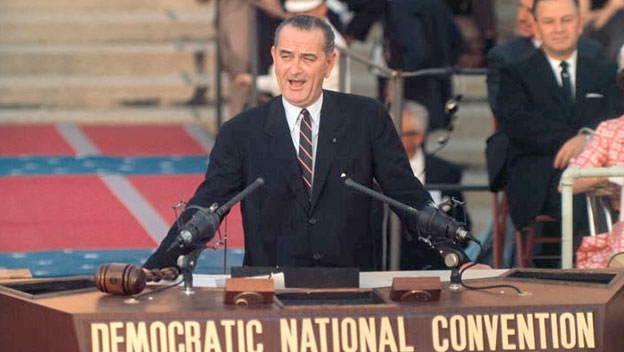
"Love him or loathe him, it is widely recognized that Lyndon Johnson was a President who knew how to make Washington work—even among those who didn’t like how he made it work and what he made it work on.
It is now considered a major accomplishment for a President to pass one or a few major bills over a four- or eight-year term: welfare reform for Bill Clinton, No Child Left Behind for George W. Bush, Affordable Care for Barack Obama. Between 1964 and 1969, President Johnson submitted, and the 88th, 89th, and 90th Congresses enacted, hundreds of legislative initiatives—in education, health care, environmental and consumer protection, civil rights, immigration reform, housing and urban affairs, the arts and humanities, criminal justice, and many other areas. Those Great Society laws and policies not only continue to shape our nation, they also fuel its public controversies and form the subject matter of our public policy dialogue to this day.I
Today many—perhaps most—citizens doubt that Washington can work at all. They oscillate between despair and cynicism about a nation’s capital paralyzed by partisan politics, dominated by special interests, tied in knots by Lilliputian lobbyists, and driven by polls, with the President and the House and Senate devoting inordinate attention to raising money for the next election."
McMaster writes, "McNamara and his assistants in the Department of Defense were arrogant. They thought their intelligence and analytical methods could compensate for their lack of military experience and education. They ignored and disrespected history."
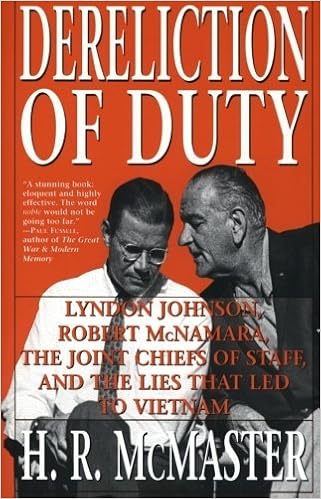
I think that it's interesting that the Author of this book is now NSA for Trump. He is among the least controversial. This was his Ph.D Thesis as a Major, where he identifies and assigns blame for the failure in Vietnam. Besides being a valuable resource and an update on the older study, "The Best and the Brightest", I believe that it can inform the NSA's mental inclination.
In his view, the war was not the inevitable failure. The political elite is assigned most of the blame (S of Def McNamara and LBJ are most derided as being out of their depth and focused on the Domestic crusades while trying to dominate the military elite) but the Joint chiefs failed to counterbalance SecD's with various US military agencies involved with damaging bureaucratic infighting. The general warning in the book is how chaotic internal politics can cause serious problems in strategic leadership and also the general incompetence America's intellectual and leadership elite that rose to lead Vietnam. The war was lead by a bunch of politicians (both civilian and military), not a group of the most suitable experts for the job.