Cult Icon
2585 replies · 37581 views
From “CYNICISM,” 1904
By Arthur Stanwood Pier
Spoiler
One of the seeming waywardnesses of our human nature is the respect for a cynic that lurks in nearly every heart. The respect is not for his character, certainly not for his disposition; but it goes out to him as a man of intellect, and is often disproportionate to his ability. To hear that a man is cynical is to accept him as of superior intelligence. There is a universal deference to what is universally deemed an unlovely and undesirable attitude of mind. The entrance of the cynic into the drawing-room produces an air of expectant interest; his rancorous comments are received as admirable wit. So, at least, according to the contemporary novels of society; so, even, — though in a somewhat less obvious and artificial manner,—according to one’s own observation. We all find more interesting the person who discusses his friend’s failings than him who dwells upon his friend’s virtues. We do not like the cynic better, but we regard him as the more penetrating and the better informed.
Hence we find him excellent company. For instance: Brown takes pains to make a pleasant impression on those whom he meets, and, in the ordinary relations of life, gets on with his acquaintances and friends very comfortably. When, therefore, the cynical observer shrugs his shoulders and intimates something to Brown’s discredit, the idea has for those who know Brown the charm of novelty, and adorns him with a new interest. Having never before held him in discredit, they feel that his detractor has got below the surface. The conviction is strengthened by the cynic’s air of mental reservation, his unwillingness to utter definitely what he knows, his manner that implies, “Oh yes, all very well, but I could tell things if I would.”
This, however, is not the only cause that contributes to the general deference. If one man declares a person to be charming, fascinating, or delightful, and another pronounces him disgusting, repulsive, or intolerable, who makes the more profound impression? The language of enthusiasm is emasculate compared with that of hatred or contempt. A sufficient reason for the undemonstrative nature of the English-speaking race lies in the effeminate quality of the adjectives that denote admirable traits. Some of them can hardly be uttered without a consciousness of a loss of virility. One has only to contrast with them the hearty gusto of our vocabulary of dislike and depreciation to perceive the tremendous advantage that the cynic enjoys.
His very name supports his pretensions to a superior intelligence. “Cynic,” for all that it meant originally “doglike,” is an aristocratic word. One is not prone to think of coal heavers, sailors, miners, as cynics; it has probably occurred to but few that their grocers and butchers are cynics. The word is erudite and Greek; the presumption is that the man designated by a term of such distinguished lineage is of education and intelligence. We have a habit of deriving ideas in this illogical way. The cynics in the humbler walks of life are not regarded as cynics, but as men soured and disappointed. And when we hear of one that he is soured and disappointed, we do not instinctively pay tribute to his intelligence.
Is there, then, no wisdom in cynicism, no virtue in disbelief? Does the undoubted suggestion of intelligence which the word implies rest entirely upon such trivial and empty grounds? Unquestionably the inner respect which persists, notwithstanding the superficial condemnation, proceeds from a dim recognition of certain useful services that cynicism does perform. An attempt to discover these and set them forth fairly need not disturb even the most believing.
A reasonable cynicism affords recreation to the mind. A man may always, with advantage to his mental health, indulge in a cynicism as a hobby; he may, for instance, be cynical of women, or newspapers, or party politics, or the publishers of novels, and be the better for it. But he is in a serious state if his cynicism includes women and newspapers and party politics and the publishers of novels. Then, indeed, is his outlook bleak and barren, and in all probability he lives and works only to malign ends.
Nearly all sane, normal people, however, enjoy one cynicism by way of diversion. It is, indeed, essential to character to have some object at which to scoff, swear, or sneer. Cynicism is never a native quality of the mind; it always has its birth in some unhappy experience. The young man finds that the girl who has gathered up for him all the harmony and melody of earth rings hollow at the test; and he drops his lyrical language and becomes cynical of women. The citizen of Boston has naturally grown cynical of newspapers. The candidate for public office who has been definitely retired to private life by being “knifed” at the polls distrusts party politics. A man reads the advertisement of a novel, then reads the novel, and thenceforth is cynical of the publishers of novels.
Yet these misfortunes have their salutary aspect. The disappointed lover, generalizing bitterly upon the sex, is not always implacable; a cooler judgment tempers and restores his passion, gives it another object, and so guides him to a safer, if less gusty and emotional love. The citizen of Boston, the betrayed candidate, the misled and disappointed reader, all have for their condition, even though they know it not, a valuable compensation; for the very experience that has brought them to this pass of reasonable cynicism has stirred their indignation; yes, in spite of their seeming inertness, indignation is now smouldering. And this is a great force; slow though it may be to start the wheels of machinery, it is still an important fuel in keeping alive the fires under the boilers of civilization. The faculty of it becomes dulled by disuse, and is the more alert and righteous for a little rasping. How impressive and commanding a quality in a man is that of a great potential indignation! It is essential to the chieftain. He may never show more than the flash of an eye, yet that will serve. And such power of indignation never came to one who had not penetrated some large bland sham, and learned thereby to hate and disbelieve all its seductive kindred…
[Cynicism] is a means toward sturdiness and independence in a man; it quickens his activities, and prevents a too ready acceptance of existing conditions. It is almost necessary to important achievement. The reverential frame of mind is inefficient when confronted with the world’s work; too much in the problems of life demands not to be reverenced, but to be cursed. There can be no useful and permanent building up without a clearing of the site; old foundations and debris have to be swept away. The man of reverential mind, who has no touch of cynicism, is unfit for this work…
In one’s own experience it is not difficult to note the efficiency which a vein of cynicism, properly combined with other qualities, gives a man. Those who are regarded as successful, or as being on the road to success, are cheerful, hopeful persons, with just this slightly cynical outlook. Those who have failed, or are failing, are just as surely the utterly cynical, the decayed, querulous, and embittered, or the supremely reverential, who have too much respect for things as they are to undertake any alteration. These are the indolent; they may work hard all their lives, yet are they none the less indolent mentally, and unalert…
…one’s cynicism must always be tempered in its sentiment and limited in its scope. A man may profitably be cynical of women, yet his faith and loyalty to at least one woman — his mother, or his sister, or the woman he loves — must be unswerving and unquestioning. A man may not be cynical of children or with children. He cannot be cynical of friends and keep them. He must not grow cynical of himself, for then nothing remains.
And the danger of cynicism is that once admitted into a man it may grow, appropriating one after another of his channels and outlets, narrowing his hopes and enthusiasms, until finally it rots the man himself.
On 11/12/2017 at 6:29 PM, Enrico_sw said:
It's hard to say. This thread has been around for more than 5 years. I've generally used it as a notebook for interesting things as of late. I chatted a lot before that about various topics.
let me take inventory...........
The first of the three posts that I didn't get a chance to answer:
Quote"From the Russian's side, in Stalingrad
I found "Enemy at the gates" quite good the first time I saw it, but not anymore. They use too much slow motion (it doesn't really feel natural) and the soundtrack is not well adapted to the movie action.
I would recommend the German film "Stalingrad (1993)". There hasn't been any good Stalingrad movies imho- all of them have significant flaws.
Some good illustrations from Osprey:


Youtube has almost all the German military newsreels posted- these newreels have a lot of valuable and fascinating footage:
4th Panzer Army/6th Army clears the Soviet armies occupying the "Don Bend" blocking their way into Stalingrad:
There are some Soviet newsreels on youtube but far less
I've a huge fan of Stalingrad and the drama of the Soviet wintercounter-offensive of 1942-1943. I've read most of the advanced books on the subject.
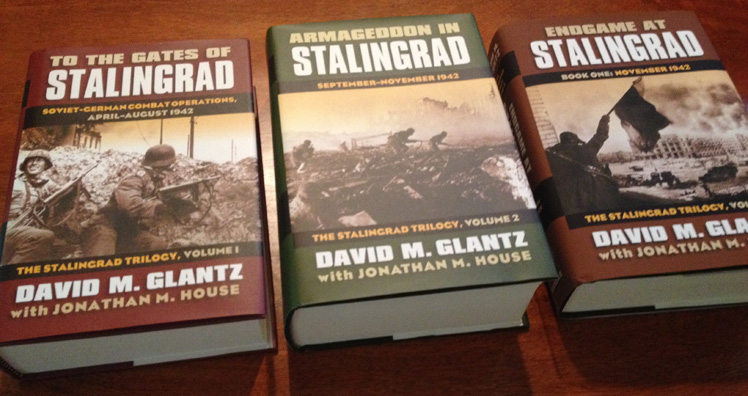
In the past ten years, Stalingrad has seen a boon in the quality of literature- the best series out of all is from two working historians: Colonel David M. Glantz and Jason Mark (He owns a small publishing house in Australia).
The Stalingrad trilogy- a definitive, massive work that took me months to finish reading. It's stronger on Soviet research than German but strong on both. There is also a fourth volume, that is composed of military reports and tables. I would put this on the short list of books that make anybody smarter in a general sense, as well. It's an advanced work and Glantz has also released a simplified one-volume book for general interest readers. :
All of Jason's Mark's books are phenomenal- but also very expensive. He focuses on extreme, hour to hour detail from the German POV.
Panzerkrieg: German Armored operations in Stalingrad Vol 1. is getting some good hype (I'm hearing from over the grapevine). "Death of the Leaping Horseman: 24.Panzer division at Stalingrad" is one of the finest military history works I've ever read. Some consider "Island of Fire" (about the battles for the Barrikady Gun Factory" ) to be Mark's best work.
https://www.leapinghorseman.com/proddetail.php?prod=9780992274931&cat=5
Quote
Yeah, Russians were highly motivated and courageous. And their culture was "strong" and in some aspects appealing. Still, their ideology was rotten.
What I hate the most with communism is that it forbids you to think anything else than what you're supposed to. It would be a pain in my ass to live with such a rule. Nowadays, political correctness is a kind of "soft" censorship. It bothers me, but at least we are free to think what we want and say what we want. The only risk is to be despised which is acceptable (sometimes it's even rewarding)
A couple of years ago, I read a book called "the Joke" by Kundera. Great book. Very interesting (the story takes place in Czechoslovakia during communism).

oh geez, I wrote a response and hit a wrong button- it closed the browser and deleted my work...
On the Soviet Union:
I always recommend that people spend the time to read "Das Kapital" (Marx). It's absolutely mind blowing and it's at the same level of importance to the holy bible and the Quran. Prof. David Harvey, of CUNY, has on youtube a free lecture series and a published, abridged version that's rewritten for easy consumption. What is read here can very easily be related to what goes on in modern liberalism. History does repeat itself in this way.
https://www.youtube.com/user/readingcapital/playlists
Marx was at heart a humanitarian, scholar and genius but his work was abused to a remarkable degree by men of action and of the opposite temperament: Militarists, thugs, and strongmen who deployed and administrated the practical application of his concepts for dictatorships throughout the world. The Soviet Union was steeped in militarism, a rejection of Christian morality, and ultra-masculinity. This lead to great cruelty.
The Red Army (RKKA) is probably the largest institution ever constructed by mankind and employed over 40 million people during the world war. It was very much the driver of the Soviet economy. Its very complicated nature, and other characteristics was also steeped in a political basis. I would say that only the elite Soviet combat units were highly motivated (Soviet Airborne, Special forces, Communist, and Tank armies) among the soviet peoples. The rest of the combat control was an "institutionalized" fanaticism secured by the Soviet military's own police state. When it functioned successfully, it involved a strict obedience to orders and resulted in combat units that attacked or defended to the bitter end instead of surrendering whole-scale.
Quote
Of course it's still relevant. Not in the way we usually think. People are usually highly uncomfortable to talk about it, because they don't really know about it. They just consider highly simplified versions of history which always lead to vision of the society that is promoted by mass media.
For example, "people" are nowadays considered suspicious. So, referendums are supposed to be dubious because the people would be subject to extreme pulsions. This view comes from the fact that media argue that the masses got dictators to power. It's not true. Intermediates gave them power: either by revolutions (where a handful of people can change everything) or by elections, but never a free election with direct universal suffrage. It was always indirect suffrage (or rigged elections). So, very often coalitions of parties (=politician tinkering) created the situations. Like in Germany (the nazis got 43.9% in 1933 which is huge and crazy, but it was not 50%. A coalition led them to power).
I sometimes think that intermediate power is prone to side with the "wind" (like weather vanes).
Also, I find it very interesting to see the effects of pacifism. By reading history books, I now really think that power balance should always be the 1st goal of a diplomatic negociation, before peace. If you place peace above all and show it to the adversary, you're screwed, because he will eat all your negociation margins and in the end he'll make war (because impunity makes him think that he is almighty). Churchill understood it better than anyone. Churchill got the media against him (and De Gaulle had the media against him as well). Pacifism is an emotion (so the media love it) and emotions are never good for diplomacy. Power balance is more rational and, in the end, it can lead to peace more easily, even if it's not the primary goal.
It's easy to say these things 80 years after, but it's always enlightenning to understand this past.
The present is a function of the past, and the largest events. The "Global recession of 2007--->" is largely responsible for the current political environment and it's effects are still strongly felt just like the peoples of the 1930s were a function of the aftermath of the World War a century ago. People don't know that the European economies were largely driven by their war machines (seven figure armies even in medium sized countries) in the 1930s which lead to global contagion.
As far as militarism goes, WW2 is still relevant today because the death of over 100 million people secured the peace that later generations took for granted. This involved large scale demilitarism in all spheres of life. The fruit of this technological competition were the nuclear weapons (USA) and advanced rocketry (pioneered in Nazi Germany).
During the Cold War, and afterwards, there was a "Hegemonic" theory that was popular in the USA- as long as US military was dominant, and its prestige intact, then a more peaceful world dominated by economics/global capitalism could open up what political scientists like Francis Fukayama called "the End of history". I think however, it was always a paper tiger after the post WW2 US Senate downsized the military. Korea/Vietnam/Iraq/Afganistan showed what it was rather quickly.
On full pacifism (100%): It's remarkably naive, as the force of arms and fear is still there even with global markets dominating most spheres of life. Gold doesn't by itself win wars or keep the peace.
hahaha
2 newly released, innovative books that I must buy and read:
king arthur dressed up as a Roman centurion...
http://knightfall.history.com/season-1/episode-1
Knightfall episode 1
"Not doubt, but certainty is what drives people insane"

Quoteon the other hand, conservative people tend to be "reactionary", that is, they react to the subversion and depravation of the left.
a classical example:
https://en.wikipedia.org/wiki/Reflections_on_the_Revolution_in_France
I've started listening to his seminars on "Nonviolent communication". They're on youtube. Great stuff!:
https://en.wikipedia.org/wiki/Marshall_Rosenberg
^ i'd like to read his book some day (Nonviolent communication - A language of life)
this one is a good read:
https://en.wikipedia.org/wiki/Games_People_Play_(book)
^
He has a 9-hour training course, an 8-hour workshop and some others on youtube. The training course probably has a lot of overlap with the book.
I finished listening to the 3 hour introduction and I find it very intriguing. Rosenberg is an expert at emotional communication and his unusual ability in this area is so obvious in his reactions and answers to the questions. I don't fully understand it on my first viewing but it's a start..
One of the insights is how Rosenberg states that how we as people are responsible to ourselves on how we react to things- he gives examples of his work with tribal Africans that had their families killed- some lived only for revenge, while others went on with minimum disturbance to their emotional life. Others expended their traumatic emotional energy in humanitarian work.
I've started listening to this:
"Making Life Wonderful (DVD 1-4, 8 1/2 hours ) is also on youtube.
I'm also interested in this Vietnamese Buddhist Monk's insights (he has many books and public appearances teaching about spirituality and the human condition) : 
On 12/15/2017 at 2:50 AM, Cult Icon said:One of the insights is how Rosenberg states that how we as people are responsible to ourselves on how we react to things- he gives examples of his work with tribal Africans that had their families killed- some lived only for revenge, while others went on with minimum disturbance to their emotional life. Others expended their traumatic emotional energy in humanitarian work.
it reminds me the philosophical-ethical trend stoicism, and its explanation of the mechanism of emotions.
the first chapter of this book is about stoicism, and its connections with modern psychology (life and works of albert ellis).
the second chapter is about the philosophy and psychology of buddhism.
i'm about to read the rest, but it seems a remarkable and very interesting book.
https://www.goodreads.com/book/show/13721709-the-antidote
https://www.npr.org/2012/11/13/162742151/antidote-prescribes-a-negative-path-to-happiness
4 hours ago, 17 Moments of Spring said:
it reminds me the philosophical-ethical trend stoicism, and its explanation of the mechanism of emotions.
the first chapter of this book is about stoicism, and its connections with modern psychology (life and works of albert ellis).
the second chapter is about the philosophy and psychology of buddhism.
i'm about to read the rest, but it seems a remarkable and very interesting book.
"The antidote" sounds like an interesting book that's needed. I'm curious as to what the rest of the book contains and your views on it!
"Nonviolent" communication is not about visualization/positive thinking (eg. "The Secret, Tony Robbins seminars). It's about erasing passive-aggressive, directly hurtful, nonconstructive and manipulative language from interactions and moving communication towards constructive outcomes by adopting a new way of speaking. It emphasizes seeing the emotional undercurrent and openly recognizing the feelings & needs of the individual. At the same time, it discourages using analytical and judgmental language. So in that example, he was moving towards the idea that those that bounced back from the trauma did so by managing their inner life in a constructive manner and the way one talks to themselves and others is a starting point.
It sounds elementary but there's clearly a lot of nuances involved and I didn't even understand a lot of the things he was pointing out in the seminar.
I can easily see the applications elsewhere (eg. in negotiations and persuasion) although it does seem that developing "non violent" communication would require a significant period of hard work in changing habits. I definitely communicate more violently than Dr. Rosenberg...
Stoicism and Buddhism always struck me as empowering but also dis-empowering in a way. Without strong passion, and powerful emotions- people are simply not driven to act and accomplish great or terrible things. "Positive thinking/visualization/hypnosis, etc." and other techniques are used by American sales forces. I've had training in it myself ( reading affirmations every morning) in the past. I see as a tool to build morale and belief in order to create action and results.
12 hours ago, Cult Icon said:
Stoicism and Buddhism always struck me as empowering but also dis-empowering in a way. Without strong passion, and powerful emotions- people are simply not driven to act and accomplish great or terrible things.
that second chapter seems preliminary, but has some profound message too. buddhism sees emotions like ever-changing weather. accordingly, it's no use to cling to any of them. thoughts are the same. the first step is to shove out from them. to learn to consider ourselves as an observer, and not as a participant in the stage of emotions and thoughts.
as for the "games people play" book, on the surface it's about communication too, but there's much more to it.
https://www.youtube.com/watch?v=nKNyFSLJy6o&t=4m11s
This is an interesting talk. The existential crisis is definitely much more applicable to young women than young men though.