Cult Icon
2585 replies · 37593 views

14 hours ago, Cult Icon said:
With emotions, I liked the classic book "Feeling Good". This teaches a lot of the "CBT (cognitive behavioral therapy)" concepts along with Albert Ellis' line of work. Basically any book that covers how to better think through emotions is interesting to me. So I've listened to many audio on anger management and stress management.
the latter book i mentioned is about this topic (the former is a thorough textbook)
http://positivepsychology.org.uk/emotional-intelligence-mayer-salovey-theory/
http://emotionresearcher.com/q-a-on-emotional-intelligence-with-john-jack-d-mayer/
https://www.youtube.com/watch?v=ds7zwjs-_UE

20 hours ago, Cult Icon said:
what did you think of part 3? I thought it was an admirable mess of a movie, like Westworld season 2.
I think that the series is the best "Heroes' journey" out there.
Part 2 (the one with the Joker) is the best IMO.
Part 3 is pretty good even if Marion Cotillard's death is crap (which is mainly to blame on Nolan: why did he keep this take?). The scenario of part 3 is good, with a very interesting progression, and a lot of interesting choices.
On 7/13/2018 at 2:32 PM, 17 Moments of Spring said:
the latter book i mentioned is about this topic (the former is a thorough textbook)
http://positivepsychology.org.uk/emotional-intelligence-mayer-salovey-theory/
http://emotionresearcher.com/q-a-on-emotional-intelligence-with-john-jack-d-mayer/
https://www.youtube.com/watch?v=ds7zwjs-_UE
with emotions, there seems to be a classical view (evolutionary) and a defunct but IMHO useful view like the triune brain theory. Paul Eckman is one of the most famous researchers. "How emotions are made" was written by a proponent of the "theory of constructed emotions". Their area shows that emotion function is not just genetic or programmed throughout all of humanity.
the EI "measurement" seems to be similar to the one Goleman promotes.
On 7/13/2018 at 7:42 PM, Enrico_sw said:
Part 2 (the one with the Joker) is the best IMO.
Part 3 is pretty good even if Marion Cotillard's death is crap (which is mainly to blame on Nolan: why did he keep this take?). The scenario of part 3 is good, with a very interesting progression, and a lot of interesting choices.
"The Dark Knight" is pretty much considered the best superhero movie ever by critics and list makers. i saw it on opening day and it was the best theater experience I ever had. There was visible response in the audience which made it even better. I went on to watch it a second time (had a good time again). And third time (not as good). Also, Heath Ledger died shortly before the film was released and the exaggerated buzz just raised the market and emotional value of the film.
I liked 1 and 2 the best as I consider them also very different movies that fulfill Act 1 and Act 2 of the heroes' journey. IMHO, 3 is where Nolan didn't really pull it off as well. I feel like in 1 and 2 he managed to avoid many pitfalls in storytelling and directorial mistakes but in 3 he made several. There are a handful of scenes in 3 that are good and stand quite well.
I didn't like Talia as Marion Cotillard. It just didn't work and felt shoe-horned in. 3 is very ambitious and I find that fact very admirable for a filmmaker.
I was in Atlantic city this weekend- crazy hot on the beach
I remember watching this ending in the theater and feeling briefly moved but the moment didn't last- the "hollywood" happy ending & the unearned "twist"... made me groan and roll my eyes..
I think that the ending was about 20-30 minutes too short- After his funeral and saving of the city, there could have been a better written and conducted aftermath to really expand and blow up the impact of the end so the fate of Bruce Wayne would seem rich and enlightening- like the Heroes' Journey story format that it followed since the beginning.
My immediate thoughts after watching the film was that I'd preferred if he just died and disappeared into history as a legend.
And if there was to be a "legacy" (robin) there would have to be a set up for it. The Police officer made zero sense as Robin. It's not cannon; Robin was an acrobat. It made no sense for Robin to find his cave and decide to do something about it. I get it that the director wanted to leave it open- ended (other interpretations are that the scene with Alfred is just Alfred's dream and Bruce Wayne died).
The ending has a homage to a "Tale of Two Cities"
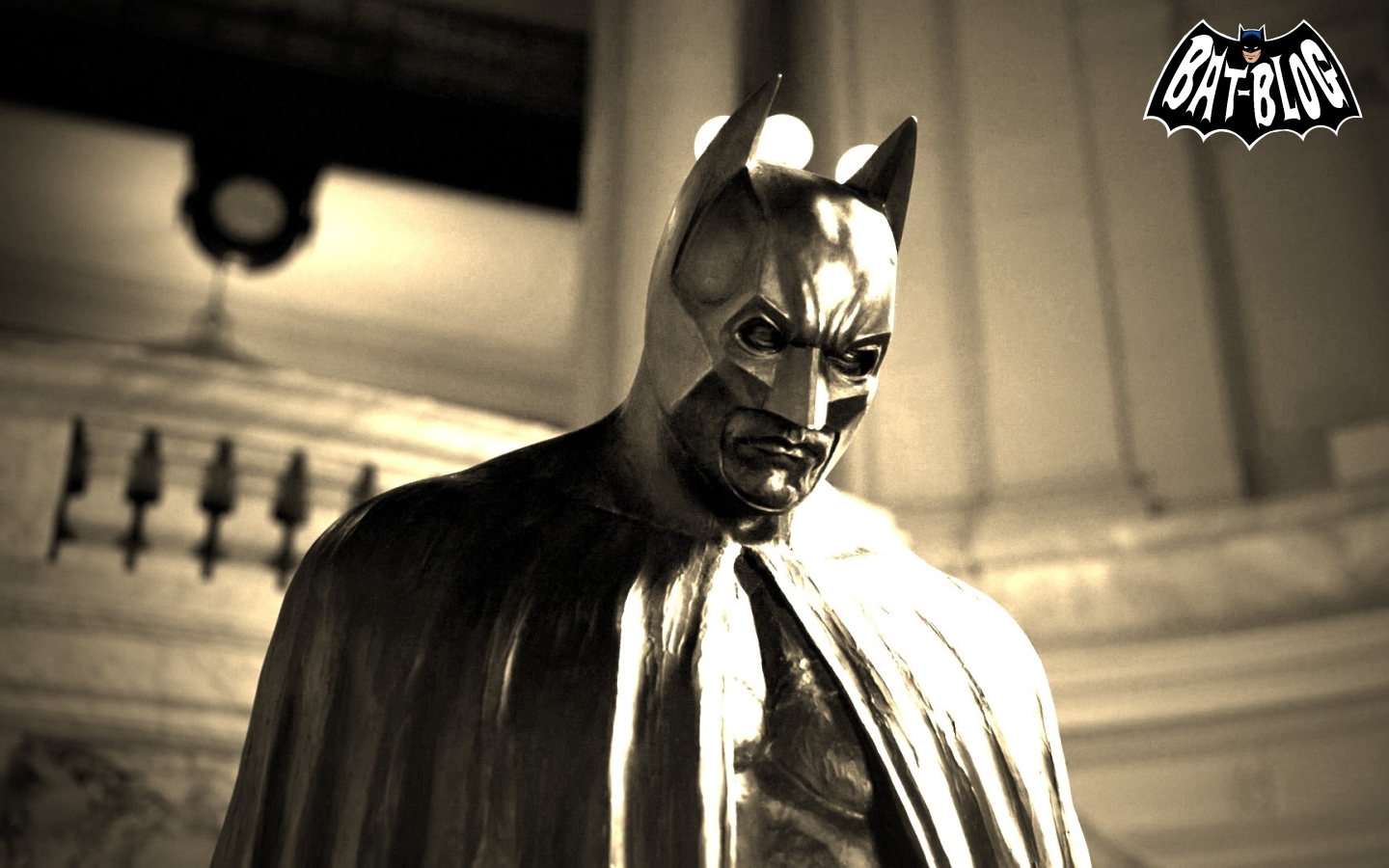
The statue was a neat touch; really cemented the legend..literally

off the top of my head..regarding classical story structure:
The Dark knight rises has a few "pivot" points that continues the heroes' journey from I and II:
-Jumps to an uneasy peace
-New Crises
-The Fall
-The Wasteland
-Rising again
-Victory and Death
-The end of the journey, and new insights
I find the basic pivots to be admirable, however, unlike in I and II, III had a lot of issues with writing , characterization, and execution.
Like this scene: In TDK, the writers jump directly from Batman at the height of his powers and end at the beginning of his decline. Then "boom!" they jump to this scene where he is crippled, depressed, and a hermit for many years. Catwoman was a worse than useless character in the way they used her in the film.
The audience is expected to "imagine" what happened in the interim; it's far too much of a stretch to put such a massive gap there. This scene was in the beginning...I believe that it was more appropriate to insert it at the beginning of Act 2 of the film.
I thought that if they were to re-write and re-shoot the film, they could have structured it like this:
- The Decline of Batman and the Victory of the Gotham Police
-Batman in retirement; an uneasy peace.
<at least 30 minutes of episodic story for point 1-2 >
-New Crises emerge
-A weakened Batman frantically tries to stop them with old methods
- Defeat and the Fall
-Batman in pain and in the Wasteland
-Batman reborn from suffering; Rising again
-Confronts the enemy with new methods and profound wisdom
- Victory and the End
- Legacy
<at least 20 minutes of story for point 1-2 >
On the "Wasteland"- a classic retelling of it is in "The Count of Monte Cristo". The Bane Prison scenes are ripped off of it imho. In TDKRs they are way too simple and short- like a lot of the movie, a lot of lost emotional impact. In "count of monte cristo", they are a major part of the story and essential in illustrating the heroes' transformation and rebirth.
Note that both stories have the "Prison mentor" character
my interest in psychology for the past 2 years has put me seriously behind my WW2 readings:
This is what I want to finish:
Priority A:
- Unit histories 2nd Tank Army, BR, 17.SS, 2.SS, 12.S
-Campaign histories: Sword Behind the Shield, Drama between Budapest and Vienna plus supporting readings (Take Budapest, Days of Battle), Prelude to Berlin.
-Books on the ideological origins of the Waffen-SS (S.A, Bad Tolz, Himmler, the SS, Freikorps, Blood and Soil) and a book on the pre-war arms race.
-Stormtrooper Tactics 1916-1918.
Priority B:
-Unit histories 1.SS, 3.SS, 5.SS, 116.Pz, 10.SS
Priority C :
-Reynold's I SSPzK, II SSPzK , Steel Inferno plus supporting works on the Normandy battles
-Island of Fire
-Didier Lodieu's 4 books on various topics
Priority D :
-Glantz's last two releases: Battle of Belorussia (with Vitebesk) and Open Don's Main attack (unpurchased)
-Demolishing the Myth
-Soviet General staff studies: Prelude to Berlin and the Berlin Operation, 1945
-Victory was beyond their grasp
-Under Himmler's Command
-books about the battle of Berlin
-books about the attack of KG Peiper the Ardennes
-books that haven't been released yet.
This includes unit history 21. Pz, Oder Front I/II, History of 1TA, Tank battles in East Prussia and Poland, Armored warfare in the battle of Budapest, Smashing Hitler's Panzers: the defeat of the 12.SS
finally a quality historian writes about what I knew about for most of my life. Where I would disagree with him is that I don't think it's necessary to be a military superpower; national defense, within borders..is enough.
Pussycats: Why the Rest Keeps Beating the West
QuoteIn the kingdom(s) of the West, something is rotten. Collectively, the countries of NATO are responsible for almost two thirds of global military spending. In terms of military technology, particularly electronics, communications and logistics, they have left the rest so far behind that it is no contest. Yet ever since the Korean War ended in 1953, almost every time they went abroad and fought non-Westerners they were defeated and had to withdraw. As happened, to cite but two recent cases, in Iraq and Afghanistan; and as may yet happen if and when Islamic terrorism spreads into Europe, as it is quite likely to do. What went wrong? How did the ferocious soldiers who, between 1492 and 1914, brought practically the entire world under their sway, become pussycats? The present study, unique of its kind, seeks to answer these questions. Chapter I, “Subduing the Young,” focuses on the way Western people raise their scanty offspring. Infantilizing them, depriving them of any kind of independence, and, in the words of a recent best-seller, turning them into “excellent sheep.” Chapter II, “Defanging the Troops,” shows how the same is happening in the military. Chapter III, “The War on Men,” examines the way in which the forces are being feminized affects, indeed infects, their fighting power. Chapter IV, “Constructing PTSD,” looks at the way returning soldiers are almost obliged to develop Post Traumatic Stress Disorder. Finally, chapter V outlines the emergence of modern societies which, exalting rights and forgetting about duty, have come very close to delegitimizing war itself. The book is about 73,000 words long. It is written in jargon-less language laymen can understand. It is also thoroughly documented. Readership should include anybody with an interest in national security, and then some.
22 hours ago, Cult Icon said:@Enrico_sw came across this
She has a very sexy voice (and a sexy smile as well).
^
yea I wonder where she went? lovely woman
I found this on youtube recently. The movie could have been better but the soundtrack was great. I wish they could re-do it with a better director. :
Got my copy of "Drama between Budapest and Vienna"- a real beast of a book that really enhances other material on the subject.
This is an unknown drama of WW2 that could really make an interesting miniseries. It'll never be made because it's politically incorrect to make a story on the POV of the bad guys.
1945 started with a sequence of decisions that aimed at keeping Hungary in the war, and keep Budapest in German-Hungarian hands. These were the Konrad I to 3 operations, and then the "Gran" attack. Meanwhile there was bureaucratic infighting between two cliches of German generals and upper level officers- the German army officers under Hermann Balck and the Waffen-SS under Dietrich. As catastrophes loomed, they sought to blame their failures on each other & manipulate the attention of their superiors at Hitler's HQ and the OKW. The Waffen SS panzer divisions were Hitler's Proletarian Guard; After the July plot (attempted assassination) he moved his trust towards the soldiers of the Nazi Party and away from the German Army.
Budapest fell in Feb 1945.
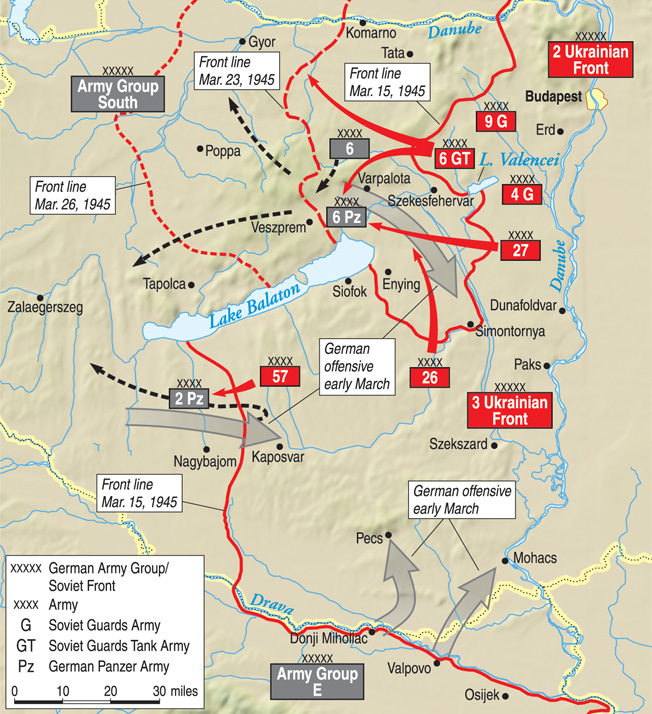
Operation "Spring Awakening" (March 1945) was the final offensive of the German military in WW2. This attack, spearheaded by the 6th SS Panzer Army- the strongest operational weapon in the German Army. It lasted little over a week, and the attacking force fell apart against the Soviet counteroffensive in chaos. The exhausted (but most storied and reputable) units of the german army attacked into the lion's den and suffered enormous losses.
The fighting spirit of the men fell apart, and they retreated in disorder while Soviet Armies were in pursuit. Hitler was so angry at the failure that he ordered his SS men to remove their armbands (a symbol of their elitism and commitment to Nazism) in shame. This order was blocked by the infamous war criminal (but beloved by his men) Sepp Dietrich- one of Hitler's closest confidants and "old fighters" who was his bodyguard on his rise to power in the 1930s. But rumors proliferated and it further reduced the fighting morale of what was left of the elite units of the Waffen SS.
The remnants of these units retreated to Austria, where they made a short last stand in Vienna and played little part in the battle of Berlin.
As a result, the gateway to Berlin- the Oder Front- lost what could have been its prime defensive asset and WW2 in Europe ended in May. An extension of the war into early August could have seen the dropping of nuclear weapons in Germany.
19 hours ago, Cult Icon said:Got my copy of "Drama between Budapest and Vienna"- a real beast of a book that really enhances other material on the subject.
This is an unknown drama of WW2 that could really make an interesting miniseries. It'll never be made because it's politically incorrect to make a story on the POV of the bad guys.
some commemorate every year the desperate outbreak at the end of the siege, by taking a hike on the trail of the retreating soldiers.
this site was made for the 70th anniversary:
http://www.szittya.com/BUDAPESTOSTROMAEAKITORES.html
the plaque reads: "for the memory of the defenders of budapest - pronounced a fortress by the germans - , who heroically held on through 103 days."
this song is about the outbreak:
https://www.youtube.com/watch?v=dLo2MLNxV_s
i heard recently that the siege and rearguard actions caused bavaria not to fall under soviet occupation.
On 7/23/2018 at 11:43 AM, 17 Moments of Spring said:
some commemorate every year the desperate outbreak at the end of the siege, by taking a hike on the trail of the retreating soldiers.
this site was made for the 70th anniversary:
http://www.szittya.com/BUDAPESTOSTROMAEAKITORES.html
the plaque reads: "for the memory of the defenders of budapest - pronounced a fortress by the germans - , who heroically held on through 103 days."
this song is about the outbreak:
https://www.youtube.com/watch?v=dLo2MLNxV_s
i heard recently that the siege and rearguard actions caused bavaria not to fall under soviet occupation.
The troops inside were one Hungarian Corps and one German Corps- with German- Hungarians evenly split. They had over 200 combat positions in the city.
The armored operations outside of the city were not seen as optimistic by the Germans. With the Konrads they hoped to extend the siege by opening up temporary channels for supplies while inflicting heavy losses and delaying the Soviet reduction of Budapest. In every operation, they quickly drew back the armored assault forces before they were bled out and did some emergency refit/reinforcement.
In OP "Spring awakening" they hoped to re-take the city as well (as achieving other objectives). The "Southwind" attack on the Gran bridgehead was done by armored forces to secure a staging area for the offensive.
There was opportunities to get the garrison out but like all the countless "fortress cities", Hitler's policy was use the garrisons as sacrificial lambs by getting them to tie up a large number of soviet formations. The fate of the majority of Festerplatzes were horrific for the defenders, often involving a massacre in the end.
Some of the final messages from the garrison indicated that the surviving soldiers were on half a slice of bread a day and were down to their last rounds of ammo.
Yea- with the Germans in Hungary and around Budapest- essentially they turned it into the focal point of the fighting and its net effect was to shield Austria and Germany proper for a period of time.
The German panzer troops were literally bled white in Hungary and in Belgium (Oct 1944- March 1945) making the offensive into Germany much easier.
An alternate scenario is if the 6th SS Panzer Army was not used after the fall of Budapest and instead pulled into OKW Reserve in order to rest & refit. Then, in April 1945 it is allocated to Army Group Vistula in order to defend Berlin. Berlin's outer ring was 150 Kilometers long and could fit 10 divisions. The second defense ring was 90 KM long. These two rings could now be occupied while historically they were mostly empty. This would most definitely extend WW2 by many weeks.
to add to the reading list:
-Battle of Budapest: 100 days and Siege of Budapest by the same author
-I already read "Under Himmler's Command" and almost finished "Bad Tolz". Added a new book- "Hitler's Girls". It is about the brainwashing of women and women's organizations.
-edit
List A:
-Books on the ideological origins of the Waffen-SS (S.A, Bad Tolz, Hiter's Girls, Himmler, the SS, Freikorps, Blood and Soil) and a book on the pre-war arms race.
-Stormtrooper Tactics 1914-1918, re read Storm of Steel, Peiper, and Grenadiers
List B:
-Didier Lodieu's 4 books on various topics
- Victory was beyond their grasp, Hold the Westwall
- Unit histories: 2nd Tank Army, BR, 17.SS, 2.SS, 9.SS and 10.SS, 12.SS, 1.SS, 3.SS, 5.SS, 116.Pz, Panzer Lehr, 14.SS, 36.SS
-Reynold's 4 x books plus supporting works on the Normandy battles
List 😄
-Campaign histories: Sword Behind the Shield, Drama between Budapest and Vienna , Island of Fire, Demolishing the Myth, Ardennes 1944
-supporting readings (Take Budapest, Days of Battle, Budapest 100 Days, Siege of Budapest), Prelude to Berlin, Berlin Operation 1945
-------------------------------------------------------------------------------------------------------------------------------------------
List D :
-Glantz's last two releases: Battle of Belorussia (with Vitebesk) and Open Don's Main attack (unpurchased)
-Oder Front I/II (unpurchased)
-Tragedy of the Faithful (unpurchased)
-East Front Drama 1944 (unpurchased)
List E
-books about the battle of Berlin
-books about the attack of KG Peiper the Ardennes
-books that haven't been released yet:
This includes unit history 21. Pz, History of 1TA, Tank battles in East Prussia and Poland, Armored warfare in the battle of Budapest, Smashing Hitler's Panzers: the defeat of the 12.SS
+ 11.Pz, SS Calvary Brigade
Bertrand Russell, said, “I would never die for my beliefs because I might be wrong.”